Julia Niedermeier
Chair of Nuclear Technology, Technical University Munich, Germany Boltzmannstraße 15, 85747 Garching
- Andreetto¹, K. Aymanns², M. Balling³,
- Benettoni¹, N. Bez¹, G.Bonomi⁴,
- Castellani¹, P. Checchia¹, E. Conti¹,
- Dackner⁵, F. Gonella², A. Jussofie³,
- Lorenzon¹, F. Montecassiano¹, M. Mosconi⁵,
- Murtezi⁵, I. Niemeyer², J. Pekkarinen⁵,
- Scarpa¹, M. Stuke³, M. Turcato¹,
- Zumerle¹
¹ INFN Padova and University of Padova, Padova, Italy
² Forschungszentrum Jülich GmbH, Jülich, Germany
³ BGZ Gesellschaft für Zwischenlagerung mbH, Essen, Germany
⁴ University of Brescia, Brescia and INFN Pavia Pavia, Italy
⁵ European Commission, Directorate-General for Energy, Luxembourg
SUMMARY
MUTOMCA (MUon TOMography for shielding CAsks) is an international project to explore the feasibility of cosmic muon tomography as a re-verification method for safeguarding spent fuel stored in thick-walled self-shielding casks. The project uses the unique properties of cosmic muons to differentiate between materials based on their density and atomic number. Emphasis is on distinguishing between dummy elements and spent fuel assemblies, which exhibit differing densities. This is achieved using two CASTOR® V/19 casks: one loaded with a mixed configuration of dummy elements and spent fuel assemblies and the other exclusively with fuel assemblies. The measurements are marking the first muon measurement of this scale ever conducted in an interim storage facility operated by BGZ. The article addresses experiment planning challenges, outlines the setup, and presents preliminary data analysis.
KEYWORDS
Spent Fuel, Waste Management, International Safeguards
INTRODUCTION
German nuclear power plants were operated using UO2 or mixed oxide (MOX) fuel sintered into pellets and stacked in zirconium-based claddings. These fuel rods are assembled into quadratic fuel assemblies. Having a length of approximately 4 to 5 meters, these assemblies vary in geometry and rod number depending on the reactor’s design. Upon completion of their service period, spent fuel assemblies are extracted from the reactor core and temporarily stored in cooling pools until their decay heat diminishes below a specific threshold. Depending on the waste management strategy, spent fuel assemblies may be loaded into casks like the CASTOR® V/19 (referred to as Castor in the following) for safe transport and storage. The Castor is specially designed for a maximum of 19 fuel assemblies from PWRs, featuring a monolithic ductile cast iron body with axial boreholes filled with polyethylene moderator rods, guarantees efficient neutron moderation. The fuel basket inside the cask, securely holds the fuel assemblies. Lids and additional polyethylene moderators, ensure a safe containment of radioactive materials. The two barriers of the lid system are permanently being monitored for leak tightness. This is performed by a pressure switch integrated in the secondary lid [1,2]. The cask has an
overall height of 594 cm and an outer diameter of 244 cm, with an empty weight of approximately 108 metric tons. Depending on the reactor type, specific cask designs are designated for the safe transport and interim storage of spent fuel. The Castor cask series of the German cask vendor GNS is one of the most frequently used casks in Germany. Different designs ensure the safe storage of waste from research reactors, vitrified reprocessing waste and fuel assemblies from boiling water reactors (BWR) and pressurized water reactors (PWR). The robust construction not only ensures the safe containment of radioactive materials but also mitigates radiation exposure risks to personnel and the environment.
Besides safety considerations, also international safeguards need to be considered. The IAEA and Euratom apply a range of technical measures to nuclear facilities and material to independently verify a state’s legal obligation that nuclear facilities are not misused and nuclear material is not diverted from peaceful purposes. The measures used to implement safeguards comprise unattended containment and surveillance instrumentation as well as the verification of nuclear material by destructive assay or non-destructive assay (NDA) measurements. The underlying principle, called the continuity of knowledge (CoK) assures that knowledge gained during inspections performed by EURATOM and IAEA is maintained at all times by containment and surveillance.
Loaded CASTOR casks exhibit a diverse range of material densities and atomic numbers, introducing challenges for traditional NDA methodologies due to the self-shielding environment of spent fuel casks. In response, cosmic muon tomography emerges as a promising alternative to conventional NDA methods. Muography, leveraging muon penetration properties, offers insights into cask contents by measuring muon flux before and after passing through an object [3,4,5]. This method can provide an advantage enabling high-resolution imaging of cask contents, thereby enhancing the accuracy of material identification and characterization.
The MUTOMCA (MUon TOMography for shielding CAsks) project investigates muon tomography as a potential technique to verify spent fuel loaded into CASTOR® V/19 casks. The project was initiated by Forschungszentrum Jülich (Germany) and carried out in collaboration with INFN Padova (Italy) and BGZ Company for Interim Storage (Germany) with support of the European Commission. By constructing detectors utilizing drift tube technology, the project enables precise measurement of particle passage and muon position information. The project focuses on effectively distinguishing between spent fuel assemblies and dummy elements within specific loading configurations.
This paper outlines essential preparations, emphasizing challenges within interim storage facilities, discusses detector design and measurement setup, and presents preliminary results from the MUTOMCA experiment.
THE CASKS AND EXPERIMENT PLANNINGS
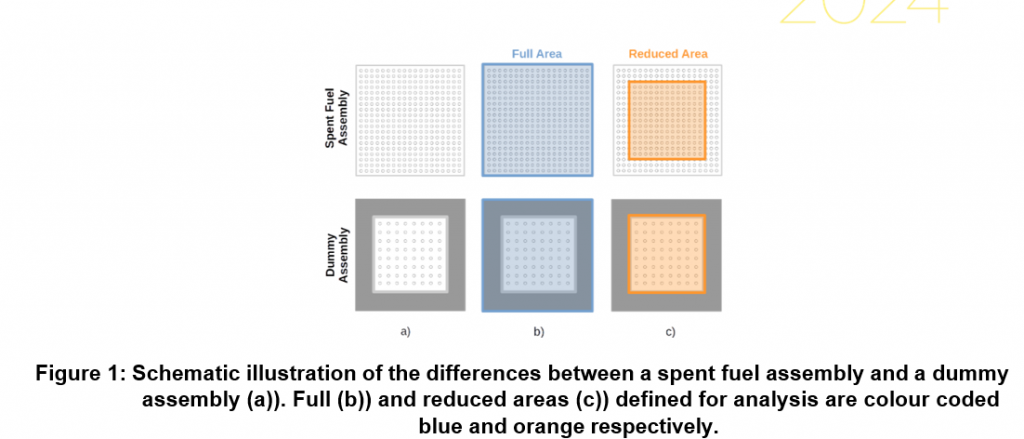
The MUTOMCA project, World’s first large-scale muon measurement initiative in an interim storage facility, commenced its extensive two-and-a-half-year preparation phase in September 2020. Central to this phase is the accurate selection of the Castor casks, ensuring compliance with accessibility guidelines and operational requirements. The two chosen casks include one with 3 dummy elements and 16 spent fuel assemblies, and another solely loaded with 19 spent fuel assemblies. Notably, spent fuel assemblies comprise a 495 cm tall structure with 18×18-24 fuel rods held by spacer grids, contrasting with dummy assemblies constructed of steel walls surrounding 8×8 hollow tubes, as depicted in Fig. 1(a). Critical planning aimed to minimize load cycles of trunnions during cask transport. It was obtained by a standard manual handling operation that maintained the availability of the crane for ongoing operations by eliminating the need for further container movement during the experiments. Precisely determining measurement positions ensured efficient detector movement around the cask, considering constraints related to special flooring and crane range limitations within the interim storage facility [6]. Gas selection for detectors underscored safety concerns, warranting the absence of explosive components and compliance with standards. Additionally, gas quantity had to be predetermined due to building regulations permitting only one gas cylinder, requiring storage space allocation accordingly. Data transfer limitations posed a challenge, as WLAN and cell phones were prohibited in the storage area. Manual transfer via discs/USB sticks restricted remote monitoring and necessitated on-site data recording. Additionally, access to the measurement setup was limited to BGZ staff working hours.
Preparations also encompassed shielding to minimize radiation dose at the evaluation station, alongside certifying electrical devices to ensure compatibility with electromagnetic signals. These considerations underscore the comprehensive planning essential for the successful execution of the MUTOMCA experiment.
DETECTORS
The detectors, constructed at Laboratori Nazionali di Legnaro (LNL) by INFN Padova, utilize drift tube technology. Each detector panel comprise 6 layers with 30 or 31 aluminium tubes, totalling 183 tubes per detector (Fig. 2(a)). The aluminium tubes, 4500 mm high with an outer radius of 50 mm and a thickness of 1.5 mm, are filled with an Ar/CO2 gas mixture (85%:15%) at a pressure of around 4 hPa and house a coaxial 100 µm Cu-Be wire tensioned at about 6 N. The choice of gas mixture is crucial
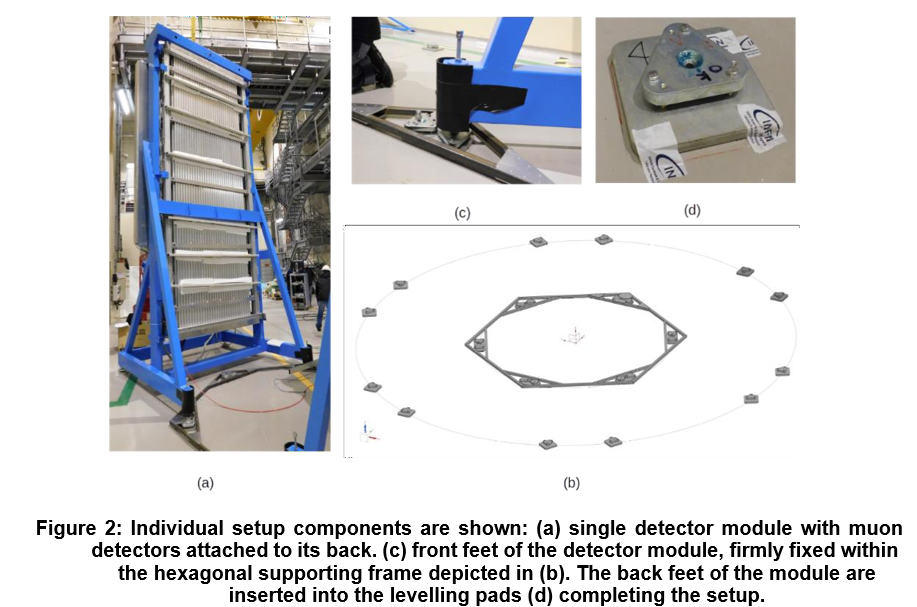
for detector efficiency as it determines the drift velocity of electrons extracted in the ionization process. The layout of the drift tubes guarantees excellent resolution in the horizontal coordinate (around 300 µm). Double readout at both wire ends enables the measurement of the vertical coordinate with
comparatively lower vertical resolution of approximately 20 cm. To improve vertical resolution, additional INFN muon detectors with four layers of rectangular drift cells, filled with the same gas mixture, are utilized. These modules, mounted behind the drift tube modules, are equipped with wires oriented orthogonally to the tubes. Accurate imaging reconstruction relies on precisely determining the positions of the two detector modules encircling the cask. Muons measured by an additional muon detector at top of the cask serve as reference (compare Fig. 3(b)). This process is supported by a customized hexagonal frame that ensures precise positioning of the detector (Fig. 2(b), 2(c)). Levelling pads (Fig. 2(d)), affixed to the floor with removable tape, are employed to set the detector frame in its measuring position, thereby ensuring a uniform measurement setup.
Initially covering roughly one third of the shell surface, the detectors can be rotated for full coverage. Although this approach compromises image quality due to reduced solid angle coverage and disfavours muons that pass through the Castor far from the centre, it suffices to demonstrate the feasibility of the muon tomography-based verification method. Additional detector information can be found in [7].
EXPERIMENT
The experimental phase of the MUTOMCA project started on 18th January, 2023 and concluded on 24th February 2023 with a total of 29 days of data taking.
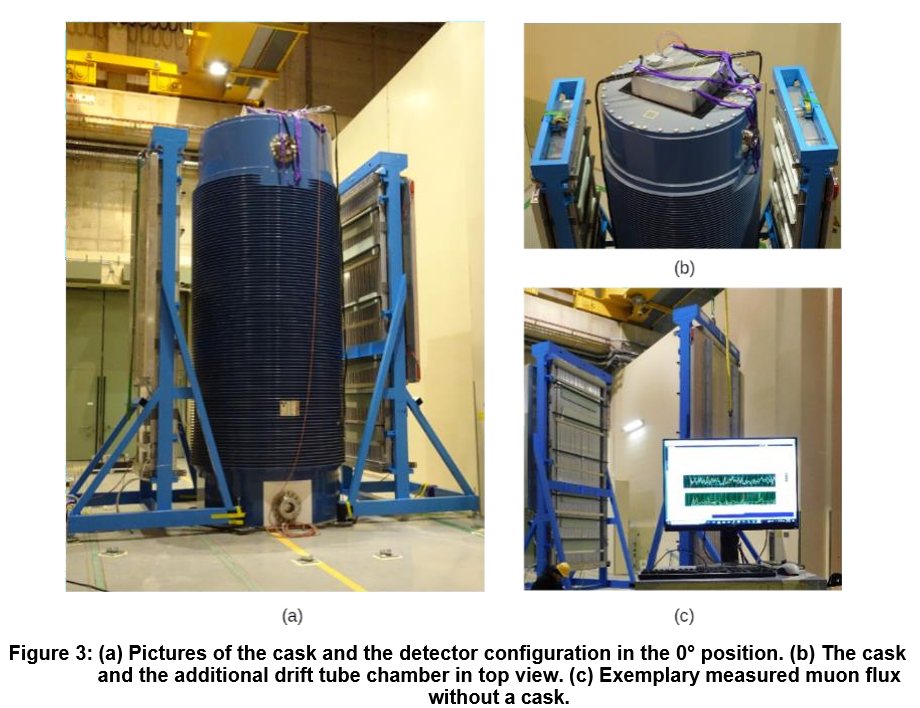
The detectors were transported from Italy to Germany using specialized transportation and installed in the reception area in the initial days. The detector testing, conducted without casks (refer to Fig. 3(c)), did not show any problem on its functioning. Subsequently, upon the arrival of the first cask (see Fig. 3(a) for measurement setup), it became evident that the primary challenge during the measurement phase would be the noise generated by neutron and gamma radiation emitted from the cask. To address this challenge, a pre-developed trigger was employed to significantly reduce the number of noise hits while ensuring the ability to detect a satisfactory quantity of absorbed and passing muons. Yet the noise level was higher than initially expected based on tests performed previously on a different cask in
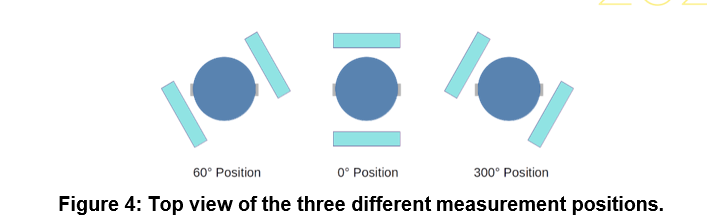
another facility. The fuel in the two casks employed was relatively hot compared to a typical loss of CoK scenario that would involve a cask that has been stored for several decades and thus be significantly cooler. As previously foreseen, a strategy was devised to measure each cask from three different positions (see Fig. 4), ensuring comprehensive 360° coverage and sufficient data collection time to acquire an adequate number of muon tracks.
RESULTS
Muons, penetrating media, dissipate energy through processes like ionization or excitation, with energy loss correlated to material density. The MUTOMCA project integrates the μCT algorithm [7], which leverages the data from muons absorbed within the target to provide insights into its internal structure.
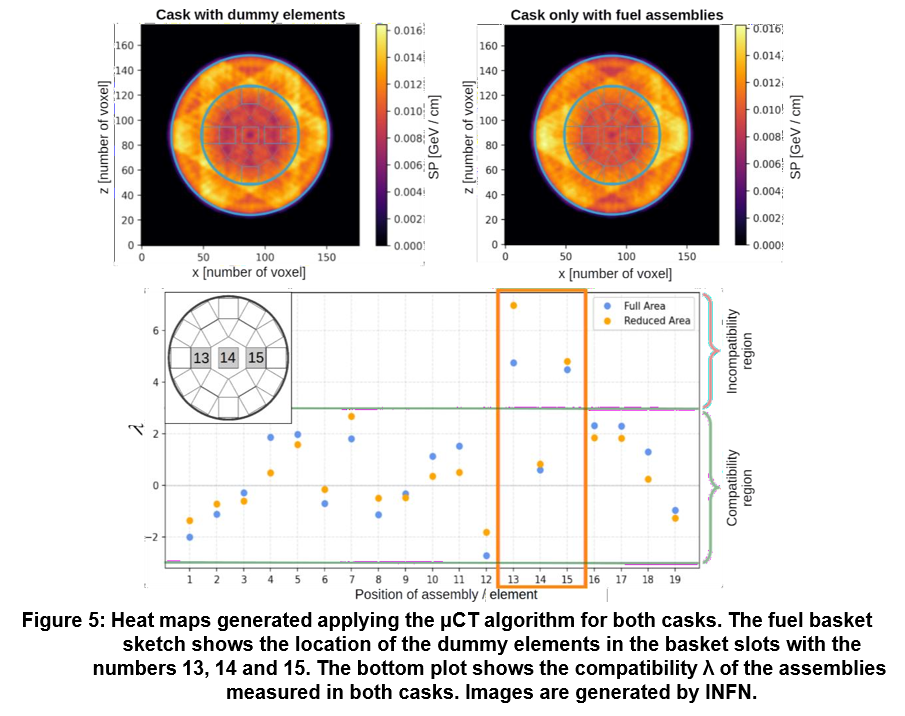
In Fig. 5 the results of the μCT reconstruction are visualized as heat maps to visualize the spatial distribution of the stopping power values. Both scenarios, a cask with dummy elements (top left) and one solely loaded with fuel assemblies (top right) are visualized. The location of the dummy elements is depicted as 13, 14, and 15 in the basket illustration in the top left corner of the lower picture in Fig. 5. For the comparative analysis, both the entire assembly area and a reduced assembly area are considered to facilitate comparison of similar structures (depicted as in Fig. 1(b) and Fig. 1(c), respectively). Stopping power (SP) in corresponding areas is compared, with calculations made for each fuel assembly and dummy element. Utilizing the compatibility λ, we can assess differences in SP’s. The
compatibility λ of the SP is plotted for each assembly and for both, full and reduced, areas. The calculation of λ is conducted using the average value of the SP measurement and the error of the stopping power σSP inside the specific area, see Eq. (1).

where i refers to the number of the spent fuel assembly and dummy element respectively. SP1 corresponds to the cask loaded with a mixed configuration of fuel assemblies and dummy elements, while SP2 refers to the cask loaded exclusively with fuel assemblies. For values exceeding λ=3, the compared assemblies are deemed incompatible, indicating a statistically significant difference. Notably, a statistically significant difference is observed between assembly positions 13 and 15, identifying the two dummy elements with λ values exceeding 3 (marked as incompatibility area in Fig. 5). However, a discernible difference for assembly slot 14 could not be resolved yet, due to an artefact produced by the reconstruction algorithm. Further investigations are underway. Preliminary results have also been published in [8,9].
SUMMARY AND CONCLUSION
The MUTOMCA project may represent a significant step forward in the field of the verification of spent fuel assemblies in thick-walled casks through cosmic muon radiography/tomography. The collaborative effort explores the feasibility of using cosmic muons to distinguish between spent fuel assemblies and dummy elements stored in CASTOR® V/19 casks. Through accurate experiment planning, execution, and data analysis, the project overcomes various challenges. These challenges include noise mitigation due to neutron and gamma radiation emitted from the casks, as well as the development of innovative filtering strategies to isolate muon hits from noise. The integration of advanced algorithms, such as the μCT algorithm, enables the reconstruction of muon paths based on absorption, providing insights into the internal structures of the casks under examination. The comparative analysis conducted between casks with dummy elements and those solely loaded with fuel assemblies yields statistically significant differences in stopping power in two out of three cases (compare Fig. 5). The results presented in this paper demonstrate the potential of cosmic muon tomography as a viable method for spent fuel verification in safeguards. Despite challenges encountered during the experimental phase, the project shows promising progress and is a step forward towards visualizing spent fuel with cosmic muons. While the measurement campaign has concluded, data analysis is still ongoing.
In conclusion, the MUTOMCA project underlines the importance of joint research efforts and the application of innovative technologies in tackling complex safeguards challenges.
ACKNOWLEDGEMENTS
Parts of this work have been funded by the German Federal Ministry for the Environment, Nature Conservation, Nuclear Safety and Consumer Protection (BMUV) under grant No. 02W6279.
REFERENCES
- Product Info Castor® V/19. GNS Geselllschaft für Nuklear-Serivce mbH
- URL: https://www.gns.de/behaelter-equipment/brennelemente-haw/castor/ (visited on 08/02/2024).
- Seth H. Neddermeyer and Carl D. Anderson. “Note on the Nature of Cosmic-Ray Particles”. In: Physical Review 51.10 (1937), pp. 884–886. ISSN: 0031-899X. DOI: 10.1103/PhysRev.51.884.
- Tanaka, H.K.M., Bozza, C., Bross, A. et al. Nat Rev Methods Primers 3, 88 (2023). https://doi.org/10.1038/s43586-023-00270-7
- Bonomi et al., “Applications of cosmic-ray muons”, Progress in Particle and Nuclear Physics 112 (2020), 103768
- Aymanns K. et al. New Technologies for Safeguarding Spent Fuel Storage Facilities. In: IAEA Symposium on International Safeguards; 2022
- Vanini S. et al., et al. Muography of different structures using muon scattering and absorption algorithms. Philosophical Transactions of The Royal Society A Mathematical Physical and Engineering Sciences. 2019 01;377:20180051.
- Lorenzon et al. “The MUTOMCA Project: Investigation of muon tomography for re- verification purposes of spent fuel casks”. In: INMM & EsardaJoint Annual Meeting. 2023.
- Bonomi et al., “Muon tomography for re-verification of spent fuel casks (the MUTOMCA project)”, in Proceedings of the Muographers 2023 International workshop on muography, Napoli, June 2023 (to be published)
0 Comments