Christoph Klein
NUKEM Technologies Engineering Services GmbH Zeche Gustav 6, 63791 Karlstein a. M. christoph.klein@nukemtechnologies.de
Felix Langer Marina Sokcic-Kostic
NUKEM Technologies Engineering Services GmbH Zeche Gustav 6, 63791 Karlstein a. M.
felix.langer@nukemtechnologies.de marina.sokcic-kostic@nukemtechnologies.de
SUMMARY
NUKEM’s system FREMES, which has been successfully applied worldwide, is able to characterize and sort both radiological and chemical contamination in soil. It combines gamma-ray spectrometry and – in its newest development stage – optical characterization and AI-supported data evaluation. The facility’s non-destructive approach provides valuable information for managing contaminated sites. Ongoing research aims to enhance its capabilities for detecting a wider range of chemical contaminants. For this, NUKEM has established a test and demonstration facility at its headquarters and is eager to present the coming result as soon as they become availabe. This versatile tool offers comprehensive data, supports decision-making, and reduces time, cost, and environmental impact in soil remediation efforts.
KEYWORDS
Site remediation, soil contamination, radiological contamination, hydrocarbons, heavy metals
INTRODUCTION
Soil contamination resulting from economical and industrial activities (especially with hydrocarbons, heavy metals, and radionuclides) poses a critical environmental challenge, impacting both human health and ecosystems.
Traditionally, soil remediation involves a range of labor-intensive, expensive, and often destructive methods. These include biological interventions (such as microbial or plant-based approaches), chemical treatments (using binding agents or reactive substances), and physical techniques (like soil washing). However, the distribution of contaminants across industrial sites is rarely uniform. This uneven spread complicates the remediation process, leading to inefficiencies and increased costs.
An innovative solution is NUKEM’s system FREMES: an efficient system for soil characterization and sorting. By automating the assessment of 100% of the soil directly on-site, we can achieve a more cost-effective site remediation. Here is how it works:
- Comprehensive Characterization: The soil is excavated and fed to a conveyor belt to produce a constant stream of material, which is analyzed regarding its contaminants portion by This characterization serves to quantify the level of contained harmful substances or to verifiy the absence thereof in the processed material.
- Targeted Isolation: Armed with precise data, soil portions of different contamination levels are isolated according to the customer’s specification. In this way, rather than treating the entire site, the focus can go exclusively on the affected material. This targeted approach significantly reduces the effort for costly remediation methods.
- Approved and extended system: Building on our success in handling radioactive contaminants, NUKEM introduces an extended capability: The FREMES system now integrates proven measurement techniques for non-radioactive pollutants. This advancement allows us to address a broader spectrum of soil contamination while maintaining efficiency. Of course, also combinations of both nuclear and conventional contaminations can be identified
To demonstrate and fine-tune these extended capabilities, NUKEM established a dedicated test facility. Here, we validate the system’s performance, optimize its processes, and ensure its reliability in real-world scenarios.
METHOD
DESCRIPTION OF THE FREMES SYSTEM
This section gives a basic description of the FREMES system for characterization and sorting of bulk materials. It describes the setup as it has been regularly applied concerning radioactive contamination. The extension to other contaminants does not influence this setup and is the same for all contaminant types (or combinations thereof), since for those only the applied measurement techniques differ.
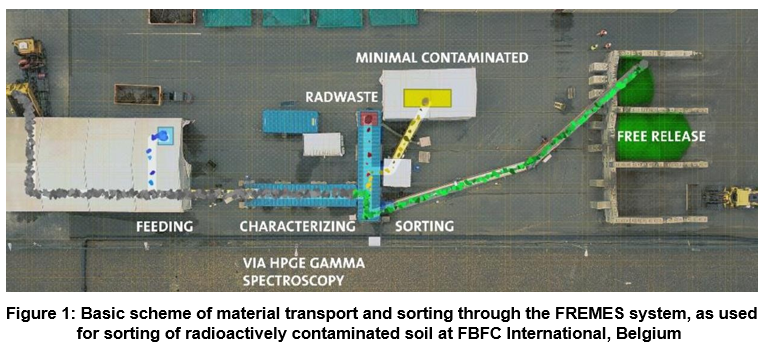
The system FREMES for characterization and sorting of bulk material can process large quantities of soil, building rubble and other (like shredded metals), in order to release it or dispose of it properly. It provides measurements in real time and with high throughputs and is therefore able to efficiently characterize large amounts of bulk material. For radioactivity measurement, it utilizes uninterrupted gamma-spectrometric measurements of a continuous material stream on a conveyor belt, which are directly evaluated and automatically sorted to material streams of customer-specified categories. (See Figure 1.)
To provide this continuous measurement is a challenging task fulfilled by our system. It can involve
- large throughputs of up to hundreds of tons per day, which also means corresponding logistical effort),
- or a high measurement interval for fine-sized separation, and therefore many single measurements (thousands per day) and their automated evaluation and subsequent sorting.
All of this has to be reliable, proven to the authorities, easily operable and within time and budget constraints.
The system FREMES is a standardized collection of transport and measurement hardware, together with the corresponding software in an easily transportable containerized design. Feeding and sorting equipment can be adjusted to each application easily, as it is also possible to vary the measurement
parameters, if it is e. g. required to have higher throughput or finer sorting portions. The current design created as an updated realization of the proven remediation concept, which NUKEM used for its own legacy site remediation in Hanau, Germany, where 33 500 tons of soil were processed in 15 months (2001 – 2003) with an average throughput of around 100 tons / hour. The new design especially was made to include up-to-date detector, computer and software systems, an update which has proven very effective ever since.
The central measurement process is performed according to the following basic steps:
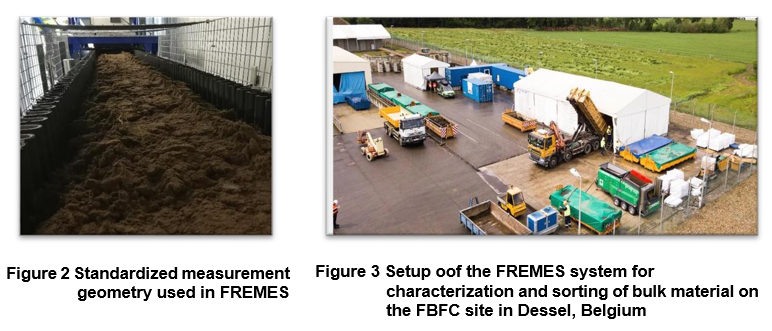
- The material is buffered and a continuous stream with a defined geometry suitable for measurement is created. (See Figure 2.)
- The material is virtually divided into cells, for which gamma spectra are subsequently taken by HPGe detectors and a scale takes the weight.
- Immediately after recording, the data is evaluated and for each separable portion the contained specific activity of the relevant nuclides is determined automatically, including uncertainty values according to ISO 11929.
- The result is compared to legal limits (including a safety margin) and classified into the categories:
- Free Release (FR)
- Conditional Release (CR)
- (Low Level) Radioactive Waste (RW)
- Material suspicious of a hot spot (HS) or other inconclusive activity pattern, which is collected and re-measured later
- According to the obtained characterization, the system directs the material to its storage destination via sorting belts.
- All results and raw data are stored on the PC, from which documentation is automatically provided at material export.
The system FREMES for characterization and sorting of bulk material can process large quantities of soil, building rubble and other (like shredded metals), in order to release it or dispose of it properly. It provides measurements in real time and with high throughputs and is therefore able to efficiently characterize large amounts of bulk material. For radioactivity measurement, it utilizes uninterrupted gamma-spectrometric measurements of a continuous material stream on a conveyor belt, which are directly evaluated and automatically sorted to material streams of customer-specified categories. (See Figure 1.)
To provide this continuous measurement is a challenging task fulfilled by our system. It can involve
- large throughputs of up to hundreds of tons per day, which also means corresponding logistical effort),
- or a high measurement interval for fine-sized separation, and therefore many single measurements (thousands per day) and their automated evaluation and subsequent sorting.
All of this has to be reliable, proven to the authorities, easily operable and within time and budget constraints.
The system FREMES is a standardized collection of transport and measurement hardware, together with the corresponding software in an easily transportable containerized design. Feeding and sorting equipment can be adjusted to each application easily, as it is also possible to vary the measurement
parameters, if it is e. g. required to have higher throughput or finer sorting portions. The current design created as an updated realization of the proven remediation concept, which NUKEM used for its own legacy site remediation in Hanau, Germany, where 33 500 tons of soil were processed in 15 months (2001 – 2003) with an average throughput of around 100 tons / hour. The new design especially was made to include up-to-date detector, computer and software systems, an update which has proven very effective ever since.
The central measurement process is performed according to the following basic steps:
- The material is buffered and a continuous stream with a defined geometry suitable for measurement is created. (See Figure 2.)
- The material is virtually divided into cells, for which gamma spectra are subsequently taken by HPGe detectors and a scale takes the weight.
- Immediately after recording, the data is evaluated and for each separable portion the contained specific activity of the relevant nuclides is determined automatically, including uncertainty values according to ISO 11929.
- The result is compared to legal limits (including a safety margin) and classified into the categories:
- Free Release (FR)
- Conditional Release (CR)
- (Low Level) Radioactive Waste (RW)
- Material suspicious of a hot spot (HS) or other inconclusive activity pattern, which is collected and re-measured later
- According to the obtained characterization, the system directs the material to its storage destination via sorting belts.
- All results and raw data are stored on the PC, from which documentation is automatically provided at material export.
EXTENSION OF THE EXISTING SYSTEM TO NON-RADIOLOGICAL CONTAMINANTS
To effectively characterize also non-radiological contaminants, our system has undergone significant advancements. Building upon the measurement process with the existing gamma spectrometry sensors, we have extended the system capabilities to include optical sensors for comprehensive characterization. These optical sensors collect data in real-time, similar to their radiation-detecting counterparts. Their AI-driven analysis considers various factors, including spectral signatures and material properties and evaluates the results promptly upon measurement. An adaptive algorithm, rooted in regulatory guidelines, can automatically classify the contaminants, e. g. according to hydrocarbon, heavy metal, or organic compound contents. Also, depending on the specific application, noth combining gamma and optical data, as well as only single sorting according to one of them is possible.
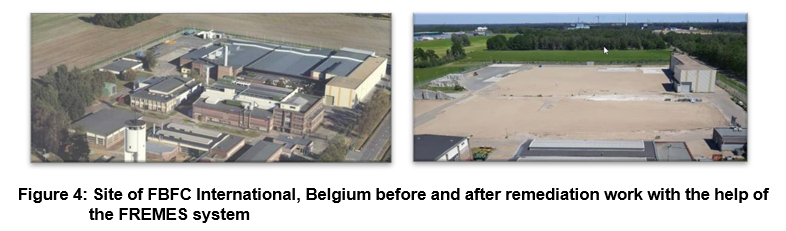
To demonstrate and optimize this extended measurement system, NUKEM has established a dedicated test facility at its headquarters near Frankfurt a. M. Here, we fine-tune the system’s working principles, ensuring seamless integration between the automatisation systems, gamma and optical sensors. Using the existing equipment from the successfully closed implementation in Dessel, Belgium, we therefore have reactivated and overhauled the system. The new measurement equipment, including optical sensors, has been integrated and both hardware and software adaptations have been performed to facilitate the system optimization.
On the test site, different material types undergo rigorous evaluation, allowing us to validate the system’s performance across scenarios. The test facility allows flexibly to study and demonstate the sorting capabilities for a wide range of materials for future applications directly at our headquarters.
EXPECTED RESULTS
As first application for the newly extended system, NUKEM aims to validate and optimize its measurement and sorting capabilities by performance of a dedicated test program for measurement of hydrocarbon contents in soil. The program objectives encompasses:
- Basic testing of the reactivated and modified FREMES system, by which we ensure the system’s intended mechanical and automatized functionalities.
- Validation of the automated sorting based on the measured results of sample
- Quality assessment of the optical sensor measurements, which are performed under operational conditions.
- Optimization of operational parameters and feasibility limits, to assess the operative capabilities and to balance precision and throughput.
The planned series consists of several phases:
- Sorting with simulated data, by which the material presence on the conveyor belt will be simulated without actual soil samples, which ensures that the system’s logic aligns with the intended functionality.
- Measurement of material boxes containing soil samples, where the focus is on precision and
- Sorting of soil samples with systematically prepared hydrocarbon contents, to evaluate the system’s ability to differentiate and sort based on varying contamination levels. Assessment of the sensitivity under practical working conditions is the main focus here.
- Sorting of soil with unknown hydrocarbon contents, where the system processes soil with prepared contamination of composition unknown to the system operators. A comparative evaluation of the results to the independently known contaminant contents demonstrates the reliability under different practical scenarios.
While the program is still ongoing at the time that this article was created, NUKEM eagerly anticipates sharing results once available.
CONCLUSION
NUKEM’s system FREMES, which has been successfully deployed globally, is able to effectively characterize and categorize both radiological and non-radiological soil contamination, for which the newest advancements have been undertaken, extending the system’s sensorical capabilites by optical methods for determination of e.g. hydrocarbons, heavy metals and organics.
In summary, our enhanced system bridges the gap between radiological and non-radiological contaminant characterization. By combining gamma spectrometry and optical sensing, we empower efficient decision-making in environmental management. The system can therefore be flexibly used both for the combined and the single application in both fields.
NUKEM’s newly extended system actually is going through the steps of validating and optimizing its measurement and sorting capabilities, via a dedicated test program focused on hydrocarbon content in soil. As the program progresses through simulated data sorting, precision-focused soil measurement, and sensitivity evaluation, NUKEM eagerly awaits the opportunity to share its results with the scientific and industrial community.
ACKNOWLEDGEMENTS
Photos in this presentation with courtesy of FBFC International.
0 Comments