Dr. Marina Sokcic-Kostic
NUKEM Technologies Engineering Services Zeche Gustav 6, 63791 Karlstein am Main marina.sokcic-kostic@nukemtechnologies.de
Dr. Christoph Klein, Dr. Frank Scheuermann NUKEM Technologies Engineering Services Zeche Gustav 6, 63791 Karlstein am Main
christoph.klein@nukemtechnologies.de, frank.scheuremann@nukemtechnologies.de
SUMMARY
Nuclear radioactive waste is produced in research institutes, nuclear power plants but also in nuclear medical institutes: before disposal a characterization of these wastes is needed. This includes the measurement of activity, the determination of contained isotopes and the estimation of necessary storage time until the material can be released. Release measurement of waste can also be required. Starting point of the characterization is the historical investigation. This forms the basis to select a suitable measurement method and the related equipment. Selection of methods and devices must consider the required detection limits, as well as the necessary dynamic range to be able to measure high active waste. Furthermore, it is necessary to interpret the measured values. Finally, the topic “verification and documentation” is discussed.
KEYWORDS
Historical investigation, characteisation methods, quality
INTRODUCTION
Nuclear radioactive waste is produced mainly in research institutes, nuclear power plants, but also in nuclear medical institutes.
Before disposal, a characterization of these wastes is needed. This includes the measurement of activity, the determination of contained isotopes, the measurement of waste package surface contamination and the estimation of necessary storage time until the material can be released. If the waste should be released, a special release measurement is required, which includes enhanced challenges in respect to the measurement quality.
This paper is restricted to solid waste, because liquid waste is normally solidified for an easier and safer handling and storing.
HISTORICAL INVESTIGATION
The starting point of any characterization is the historical investigation. In that matter all available information about the waste like origin, basic material, processes etc. are collected. Samples may be taken and analyzed in a radio-chemical laboratory to check assumptions and to complement available information. As a result of the investigation, a basis is formed to select suitable measurement methods and the related equipment.
CHARACTERIZATION METHODS
The next step is the selection of the characterization method. First the decision has to be made if representative samples should be taken from the waste and analyzed in a radio-chemical laboratory or if non-destructive measurements should be performed on waste packages like drums or containers filled with waste.
The first method delivers very precise results in respect to the sample analysis, but a completely adequate sampling is difficult or impossible. The non-destructive measurement allows a 100% measurement of the waste, but gives incomplete results (i.e. no alpha emitters can be measured etc.).
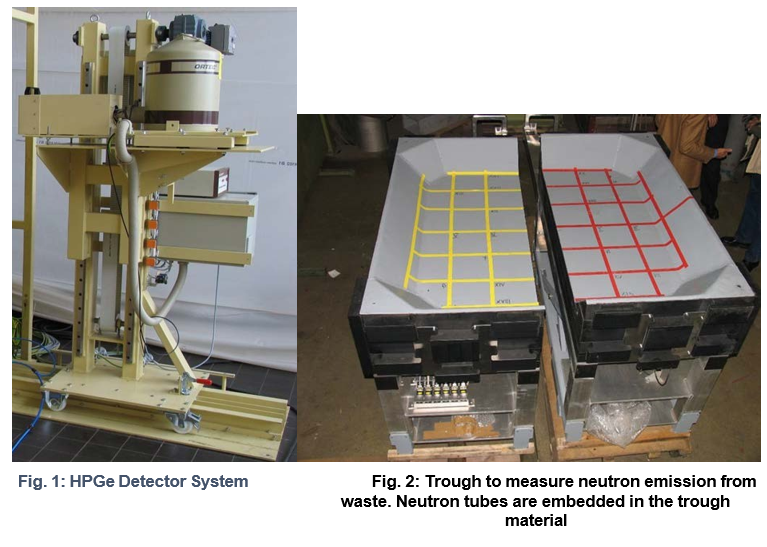
In most cases the solution is a mixture of both. It is based on the measurement of gamma emission from the package by dose rate meters and HPGe detectors (see Fig.1). The results are then corrected for effects by the measurement process, for example for gamma absorption by the waste matrix. These corrections are made using theoretical model calculations, e.g. by from MCNP.
As a result, we have correct values for the gamma emission by measuring the complete waste: but the result is incomplete in respect to the full characterization of the waste, because some aspects are not considered like the content of alpha or pure beta emitters. The presence of such emitters can be implied by the historical examination of the waste as well as by analysis of samples in a radio-chemical laboratory. To overcome the problem, that a complete measurement of such emitters is not possible for large waste packages, the key nuclide method is implemented. Key nuclide method means that easily measurable isotopes are used to estimate those, which are not or difficult to measure, using fixed isotope ratios (called isotope vectors), which are established from sample analysis and / or from historical information.
The requirements for the applied methods change depending on the waste activity. For high or middle active waste, the isotopes Co-60 and Cs-137 are most important, which are easy to measure. As long as these isotopes are dominant, i.e. as long as the waste has a relatively high activity, other isotopes are of lower interest.
In contrast, for very low level waste, all isotopes are of importance. Therefore, it is more difficult to establish a reliable key nuclide method.
Another aspect is that for high level waste the package can be scanned with a single device like an HPGe detector. In case of very low level waste the scanning is connected with large errors due to the low count rate numbers. Therefore, a measurement should be preferred with radiation received by a large solid angle.
MEASUREMENT INSTRUMENTATION
After selection of the measurement methods comes the selection of suitable instrumentation. The description of the equipment in radio-chemical laboratories will be excluded in this paper because this is a standard over long time. There is some progress by the implementation of mass spectrometry devices. For ultra-low activities, i.e. in the range of 10kB down to the detection of single events, the mass spectrometry is sometimes more efficient than measuring the emitted radiation, especially if the decay rates are low.
GAMMA MEASUREMENT
The instruments to measure the gamma emission are divided into instruments, which are spectrometers measuring individual gamma lines, and instruments, which are only measuring unspecific – total intensity of gamma emission [8].
The last group is mostly based on instruments with Geiger-Mueller counter tubes. They are working reliable over long time. If equipped with filters they measure dose rates over a wide energy range (i.e. from 100kev to 1.3MeV). The measurement range can be extended by using two different tubes with different sensitivity. The integrated electronics changes between the tubes according to the counting rate to have all times the optimal tube. In the last years a dead time free operation mode was introduced, which does not need dead time corrections ad the same time expands the measurement range [1].
The first group of instruments as mentioned above includes the HPGe spectrometers which have the best energy resolution and a relative high sensitivity for gamma radiation. The disadvantage is the need of liquid nitrogen to cool down the Ge crystal. The newest development, electrical operated cooling systems need no nitrogen or recycle the evaporated nitrogen for a long term operation over months.
Another problem, especially if measuring high active waste, is the effect that the isotope lines may be shifted in the spectrum comparing spectra with low and very high count rates. This problem can be solved if digital signal processors are used to analyze the pulses as produced by the spectrometer. The digital processing allows compensating so called ballistic shifts arising from the time to collect all charges contributing to peaks with high energy like the peaks from Co-60 isotopes.
Spectrometers with crystals, which do not need cooling (like NaI, CdZnTe etc.) are alos existing but these instruments have not the same high energy resolution like HPGe detectors.
NEUTRON MEASUREMENT INSTRUMENTATION
If uranium or trans-uranium isotopes are contained in the waste, the measurement of emitted neutrons is a proper method to estimate the activity of fission material [2], [3]. The advantage of neutron measurements is the highly penetration of the waste and the package (i.e. drums or containers) by the neutrons and the fact, that neutrons are only emitted by very heavy isotopes like the Uranium and Trans- Uranium isotopes [7]. To detect neutrons, fission chambers or He-3 filled proportional counters are used.
Both detector groups are working like proportional counters. In case of fission champers, the inner side of the counting tube is covered with highly enriched Uranium. Incoming neutrons induces fission processes which release charged fission parts ionizing the filling gas of the tube. In case of He-3 counters, the filling gas contains He-3 isotopes. Due to collisions between neutrons and the He-3 nuclei the gas inside the tubes is ionized by the He-3 isotopes [2], [3].
SPECIAL MEASUREMENT INSTRUMENTATION
In the next chapters some typical scenarios are described to show radiological characterization procedures including their problems and possible solutions.
HIGH ACTIVE SOLID WASTE CHARACTERISATION
High active solid waste is mostly generated by operation of nuclear power plants. The origin of radiation comes mainly from the presence of the isotopes Co-60 and Cs-137. Other isotopes are of minor importance. The target of the waste characterization is to fulfill conditions of waste storages mainly in respect to the safe waste transportation, the safe waste storage and the estimate of storage time until a conditional or free release of the waste is expected [6].
As long as the waste is not preprocessed by chemical or mechanical separation, the waste isotopic composition can be estimated from the burn up process in the power plant, which can be described by computer programs like the ORIGEN code.
If the assumption of unprocessed waste is correct, then the key nuclide method can be applied using Co-60 and Cs-137 as key nuclides. This reduces the measurement problem to the detection of gamma radiation emitted by Co-60 and Cs-137. The standard instrument to measure the isotopes is an HPGe detector system (see Fig. 1).
For very high active waste the problem connected with the limited count rate of HPGe spectrometers comes up [9]. The limit is in the range of 1E+6 up to 2E+6 total counts of the spectrum per second. If the counting rates are too high, the distance between detector and waste can be increased or an absorber may be placed between detector and waste. The solutions are limited by the available space in the hot cell, where the waste has to be measured. Also the reduction of the HPGe crystal size does not help much because the size reduction reduces the peak areas at the expense that the Compton HPGe scattering background in the spectrum is increased.
The consequence is that the measurement has to be performed with a detector having a much higher dynamic range than HPGe detectors. The best replacement for HPGe detectors is an arrangement of
Geiger-Mueller detectors with different sizes, i.e. different sensitivities. Such an arrangement can cover a range up to 1Gy/h and more. The big advantage of Geiger-Mueller detectors is their excellent stability, the relative low energy dependence of the measurement if suitable filters are used and the low background sensitivity.
WASTE CONTAINING FISSILE MATERIAL
In case of nuclear accidents waste may contain fission material like uranium and trans-uranium isotopes. Under normal circumstances material containing fission isotopes is not counted as waste. But the accidents at Chernobyl and at Fukushima have shown the need of systems to characterize waste with fission material.
This problem may be handled by a trough construction with integrated neutron proportional counting chambers as shown in Fig.2. The emitted neutrons are moderated in the moderator material placed below the trough and then detected by the neutron tubes filled with He-3 gas [5].
Together with Geiger Mueller counter tubes, also integrated in the table, this construction allows the characterization of waste containing fission material and or gamma emitting isotopes [4].
RELEASE MEASUREMENTS
Release measurements of waste have the highest requirements in respect to precision and quality of the measurement. The technical challenge is to realize a high material throughput per hour and a 100% sampling of the waste.
The state of the art procedure is to shred the waste to a grain size of some cm and the filling of the waste onto a conveyor band up to a height of 10 cm. This procedure homogenizes the waste and reduces the influence of the waste density to the measurement process. Because the sensitivity of a single HPGe detector is limited, an array of detectors is used. With the HPGe detectors a nearly 100% sampling in respect to the gamma emission can be performed. Beta emitters from the waste surface can be measured by additional mounted beta counters. Alternatively, samples can be taken and analyzed in a radio-chemical laboratory. The analysis can also be used to check the gamma measurement, the isotope composition and alpha emitting isotopes.
Comparing the results from different measurement techniques enhances also the quality of the measurement.
GRAPHITE WASTE FROM NUCLEAR REACTORS
Graphite waste which was original used as moderator for nuclear reactors gives an example, that sometimes very special methods are needed for the waste characterization.
The problem with graphite is the possible content of tritium, which is absorbed like water by a sponge. The tritium can only be measured if separated from the carbon as tritium gas. The tritium gas is measured while mixed with other gases and filled into proportional counter tubes. The problem is not the measurement but the separation from the graphite. One solution is to oxidize the graphite by producing CO2 gas which is mixed with the tritium gas. Another method is to heat carefully the graphite to evaporate the contained tritium.
Special care has to be taken by handling the graphite because Wigner energy may be stored in the graphite. The Wigner energy is released by collision between neutrons and graphite. The stored energy can be uncontrolledly released and may set the graphite in fire.
QUALITY SURVELIANCE
The characterization of radio-active waste is closely connected with safety aspects like shielding of radio-activity, storage of waste or environmental and personal protection.
Therefore, quality surveillance is an important feature. Two ways to perform this exist and they are not excluding each other:
First the measurement results should be compared with the expectations on the basis of historical investigation: but an agreement between results and expectations alone is not enough.
Second is an independent check of the results by an alternative method. Normally it is enough to perform this check by taking samples and analyzing these in a radio- chemical laboratory.
In case of serious discrepancies, the full characterization procedure has to be repeated to localize the origin of the discrepancy.
The quality surveillance also has to include a detailed documentation of the different steps of measurements with a detailed protocol at the end of the procedure.
CONCLUSION
The waste characterization is a challenging work starting with historical data of the waste and finishing with the interpretation of in situ measurements and results from samples analyzed in radiochemical laboratories. Waste properties have to be taken into account by Monte Carlo simulation whenever possible.
The used instrumentation has not only to be checked for a correct measurement but also the dynamic range must be large enough to cover the measurement range.
Finally, the results must be secured by a quality surveillance management which also includes a detailed documentation of the measurements and their interpretation.
REFERENCES
- VacuTec Meßtechnik GmbH, Dornblüthstrasse 14 a, 01277 Dresden
- Sokcic-Kostic, R.Schultheis, Neutronenmessverfahren für den Nachweis von Transuranen im Kernbrennstoff-Kreislauf, atw (4)/2014
- Sokcic-Kostic, R.Schultheis, Neutronenmessverfahren für den Nachweis von Transuranen im Kernbrennstoff-Kreislauf, VGB Powertech (5)/2014
- G.Simon, M.Sokcic-Kostic, Drum Monitoring System for Gamma and Neutron Measurements of Waste Drum, KONTEC 2005, Berlin, Germany
- G.Simon, M.Sokcic-Kostic, Neutron Monitoring System NMS for Alpha Activity Determination of Waste in Hot Cell, KONTEC 2007, Dresden Germany
- Schultheis, M.Sokcic-Kostic, Radiological Characterization of Radioactive Solide Waste by Gamma Measurement, Jahrestagung Kerntechnik 2008, Hamburg, Germany
- G.Simon, M.Sokcic-Kostic, Calibration Methods for Different Neutron Measurement Systems for Waste Management Jahrestagung Kerntechnik 2007, Karlsruhe, Germany
- Sokcic-Kostic, F.Langer, Ch.Klein, R.Schultheis, Measurement techniques for the sorting and characterization of radioactive material in waste treatment centers: actual instrumentations, existing problems and outlook to the future, KONTEC 2015, Dresden, Germany
- Sokcic-Kostic, Radiation Instrumentation and Measurement Technologies for High Radiation Fields. AMNT 2017, Berlin, Germany
0 Comments