Norman Dünne, Jeremy Bousquet, Daniel Eckert, Andreas Wielenberg, Andreas Schaffrath
Gesellschaft für Anlagen- und Reaktorsicherheit (GRS) gGmbH Boltzmannstraße 14, 85748 Garching bei München Norman.Duenne@grs.de, Jeremy.Bousquet@grs.de, Daniel.Eckert@grs.de, Andreas.Wielenberg@grs.de, Andreas.Schaffrath@grs.de
Jörg Starflinger
Universität Stuttgart
Institut für Kernenergetik und Energiesysteme Pfaffenwaldring 31, 70569 Stuttgart Joerg.Starflinger@ike.uni-stuttgart.de
SUMMARY
MISHA, a cooperative project between GRS and IKE, aims to establish a calculation chain for innovative MMR designs using the GRS developed simulation codes ATHLET and FENNECS. The Los Alamos National Laboratory’s Special Purpose Reactor was chosen as a reference design. To perform such a simulation, an initial model in the Monte Carlo code Serpent is required for the creation of a macroscopic cross-section library and as a reference to validate the future FENNECS model.
The Serpent model is presented and calculated core eigenvalues for different core configuration are compared to earlier work by the Idaho National Laboratory. The model shows good results for the excess reactivity without absorbers, reasonable shutdown margins and reaches the critcal state in a configuration similar to the reference.
KEYWORDS
SMR, MMR, Serpent, MISHA, SPR
INTRODUCTION
Micro Modular Reactors (MMRs) are a subcategory of Small Modular Reactors with an electrical power lower than 10 MW. In recent years they garnered research interest as potential power sources for remote or mobile applications, featuring a high transportability and little effort of deployment at location. These MMRs often feature innovative designs which differ significantly from the established reactor types.
One of these designs is the Special Purpose Reactor (SPR) designed by Los Alamos National Laboratory, a reactor concept for a 5 MWth, 2 MWel heatpipe-cooled fast reactor with a solid, monolithic core, also called Megawatt in earlier design stages [1]. The design was chosen as a reference as detailled information as well as thermal and neutronic analysis by the Idaho National Laboratory (INL) is publically available [2], [3]. It also features several similarities to the commercial eVinci® design by Westinghouse [4], [5], which has recently received a Front-End Engineering and Experiment Design contract by the Department of Energy to support the planned test reactor at INL [6].
In detail, the SPR features a hexagonal steel monolith core with an active length of 1.5 m and a diameter of 1.012 m flat-to-flat, which is divided azimuthally into six segments, each containing 352 UO2 fuel elements and 204 potassium heat pipes. A total mass of 5.22 t UO2 with 19.75 wt% U-235 enrichment is contained within. In the center of the core is a control void where a solid and an annular control rod
can be inserted. The core is surrounded by an Al2O3 reflector, in which 12 control drums are located. The control drums are rotatable with a crescent of absorber material on one side and function as the primary reactivity control. The core and radial reflector are contained within another steel vessel with additional neutron shielding. The absorber material in the drums, the control rods and the shielding is B4C with 90% Boron-10. A recuperated brayton cycle is used for power conversion. [2]
The MISHA project, a cooperation between GRS and the IKE of the University of Stuttgart, aims to esta- blish a simulation model for such MMRs as a coupled simulation between the thermal-hydraulic system code ATHLET [7] and the neutron diffusion code FENNECS [8], which are both part of the GRS code package AC2 [9]. To perform the FENNECS calculation, pre-computed macroscopic cross-sections are required. These can be calculated using the Monte Carlo code Serpent® [10] developed at VTT. The Serpent results also function as reference for later FENNECS calculations.
MODELLING
Based on the neutronic analysis and the MCNP model by INL [2], [3], a detailed model of the SPR was created in Serpent. The purpose of this study is to compare the INL results with Serpent calculations, which will in the future provide macroscopic cross-section data for the dynamic simulations with FENNECS.
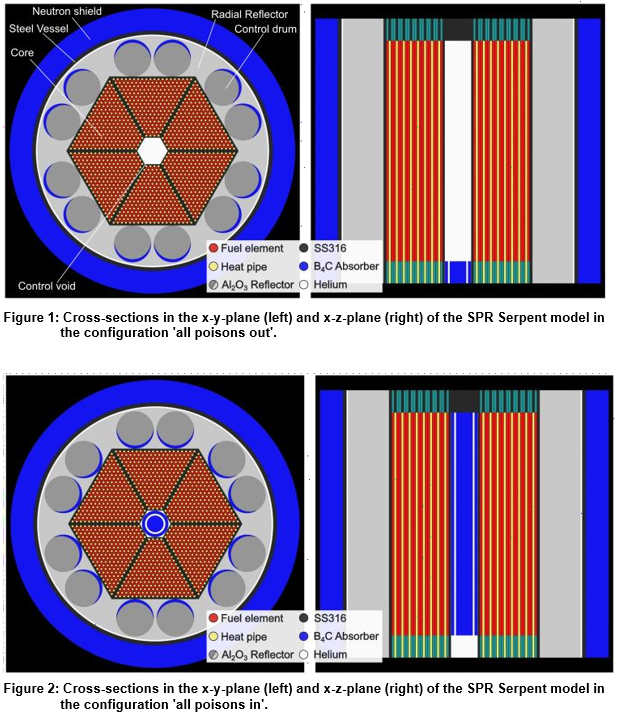
While precise information on some of the details of the model like temperature of the different materials or the exact location and orientation of the control drums and the absorber crescent within, is not explicitly given, the Serpent model recreates the geometry and material data as closely as possible. It features, from the centre outwards, a hexagonal central channel for the central control rod and control annulus, the hexagonal steel monolith with the 2112 fuel elements and 1224 heat pipes, the radial reflector with 12 control drums and an additional steel vessel as well as a neutron shield. The control drums are distributed around the core in groups of two along the outer edge of the core segments, drums within a group have the same rotational position and each group is rotated by 60° when compared to its neighbours. Above and below the active core region are neutron reflectors made from steel with additional BeO elements in the fuel channels.
Core configurations
The core configurations ‘all poisons out’ and ‘all poisons in’ are pictured in Figure 1 and Figure 2 respectively. The first configuration has the absorber crescents of the control drums rotated out of the core as far as possible and has removed the two central control elements from the active core region. The second configuration has the control drums rotated in and both central control elements in the active core, reducing reactivity as much as possible. In the figures, yellow represents potassium heat pipes, red the UO2 fuel elements, the steel monolith is black and the Al2O3 reflectors are grey, lighter in the radial reflector and darker in the control drums. The absorber material B4C in the control drums, the central rods and the outer shielding is colored blue. The darker turqoise tone above and below the fuel elements is BeO in the bottom and top reflectors. The empty spaces in white are filled with Helium.
The other core configurations investigated are ‘all control drums in’, which rotates the drums into the core like in Figure 2, but does not apply the two central control elements, and ‘annular rod in’ as well as ‘solid rod in’, which apply either of the central elements with the control drums rotated out of the core. Finally, the ‘criticality’ configuration of the core represents operational state, which rotates all control drums (CD) by the same angle, so that the reactivity of the core is closest to 1. INL reaches this state with a rotation of 48°, while the Serpent model requires a rotation by 52°.
RESULTS
The reactivity values for the different core configuration calculated by INL and with Serpent are listed in Table 1. The table also includes the uncertainty of the Serpent results, which was achieved by performing 1000 simulations with a neutron population size of 300000 for each configuration. This number of calculations was chosen to keep the uncertainty of the reactivity coefficient sufficiently low compared to the difference between the reference and our own results, which is calculated as

and given in pcm.
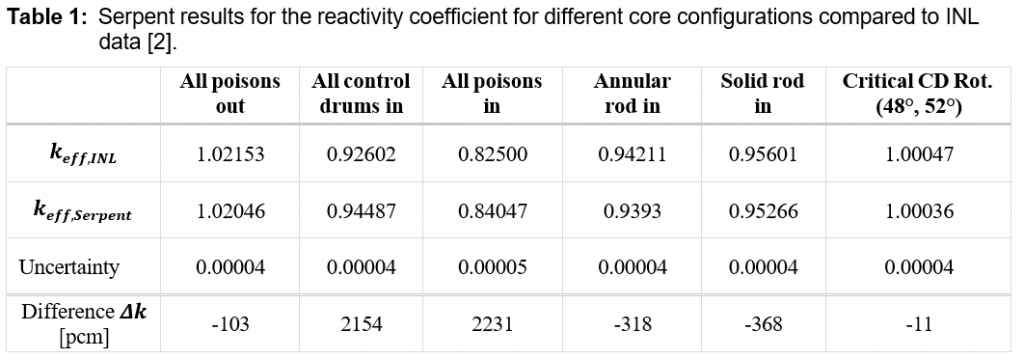
The reactivity coefficient for the test case ‘all poisons out’ is in good agreement with the results published INL, only slightly underestimating the reactivity of the core without applied absorbers. The test cases with active control drums show a comparatively large difference of roughly 2000 pcm on the multplication factor. While an attempt was made to recreate the material data and geometry used by INL as closely as possible, especially the control drums proved to be difficult to model, as neither the exact position of the drums, the shape of the B4C absorber arc nor the precise rotation of the individual drums compared to each other is known but had to be estimated from figures.
Different approaches to more closely match the results published by INL, like slightly shifting the fuel pin filled steel monolith segments closer to the control drums, modifying the absorber shape or increasing the amount of B4C in the control drums, have been succesfully investigated. However, a decision was made to prioritize matching known geometries and parameters over results. The increased reactivity for the case ‘all control drums in’ is still below the desired shutdown margin of 𝒌𝒆𝒇𝒇 ~ 0.95 postulated by INL [2], so the deviation can be considered a more conservative estimate of the reactor’s shutdown capabilities.
The results for the cases focussing on the central control elements are signifcantly closer to the ones calculated by INL which is positive for the verification of the model, but these elements are mainly applied to reach a strongly non-critical state during transport. The operational state, which is of greater interest for the project, is achieved by rotating the control drums in slightly further than the reference. As seen before, the neutron absorption effect of the control drums is underestimated by the model, so the drums have to be rotated in by 52° instead of 48° to reach criticalilty conditions.
Aside from adjustments to better fit the modelling capabilities of FENNECS and its external meshing tool PEMTY, we consider the work on the Serpent model to be finished for now. Results obtained with Serpent are taken as reference results for the rest of the project. Comparisons to INL results mainly served to identify significant modelling discrepancies. The goal of the project however is a coupled simulation model of the SPR for safety analysis, not to exactly reproduce INL results. Underestimating the shutdown margin slightly when using the control drums works out as a more conservative assumption of the reactor’s shutdown capabilities and is thus not a problem for future work.
In summary, the Serpent model
- produces good results for the excess reactivity when no neutron absorbers are applied
- keeps an appropriate, if more conservative, shutdown margin when applying the control drums
- achieves criticality with a control drum angle very similar to the INL reference
Macroscopic cross-sections calculated with this model will be used in the future with the neutron diffusion code FENNECS to analyse the performance of the SPR in coupled simulations with ATHLET, in operational as well as accident conditions. Also, Serpent results serve as reference for comparison with future FENNECS results, as the amount of published data is very limited.
CONCLUSION
Based on earlier work by the Idaho National Laboratory, a detailed model of the LANL Special Purpose Reactor was created in Serpent. The model was tested for several configurations of the control drums as well as the central control rods and results were compared with INL. While reactivity values for the case ‘all poisons out’ agree well with the INL data, the cases applying the absorber objects result in comparatively larger deviations. Especially the control drums prove to be challenging to model accurately, resulting in significantly increased reactivity and reduced shut-down margins, however the reactivity remains below the desired margin of 5% stated by INL.
Macroscopic cross-sections calculated using this model will be used in further simulations with the codes FENNECS and ATHLET as part of the MISHA project and results obtained from Serpent will be used as reference data for core parameters determined using FENNECS.
REFERENCES
- R. McClure, D. I. Poston, V. R. Dasari, and R. S. Reid, “Design of Megawatt Power Level
Heat Pipe Reactors”, Los Alamos National Laboratory, Los Alamos, NM, Tech. Rep. LA-UR-15- 28840, Nov. 2015.
- W. Sterbentz, J. E. Werner, M. G. McKellar, A. J. Hummel, J. C. Kennedy, R. N. Wright, and J.
- Biesdorf, “Special Purpose Nuclear Reactor (5 MW) for Reliable Power at Remote Sites Assessment Report”, Idaho National Laboratory, Idaho Falls, ID, Tech. Rep. INL/EXT-16-40741, Apr. 2017.
- W. Sterbentz, J. E. Werner, A. J. Hummel, J. C. Kennedy, R. C. O’Brien, A. M. Dion, R. N. Wright, and K. P. Ananth, “Preliminary Assessment of Two Alternative Core Design Concepts for the Special Purpose Reactor”, Idaho National Laboratory, Idaho Falls, ID, Tech. Rep. INL/EXT- 17-43212, May 2018.
- Arafat, J. v. Wyk, “eVinciTM Micro Reactor”, Nuclear Plant Journal, March-April 2019
- “eVinci™ Microreactor” https://www.westinghousenuclear.com/energy-systems/evinci- microreactor (2024)
- “Three developers get FEEED funding to test microreactors in INL’s DOME”
https://www.ans.org/news/article-5467/three-developers-get-feeed-funding-to-test- microreactors-in-inls-dome/ (2023)
- Schöffel et al. ATHLET 3.4.0 User’s Manual. GRS-P-1/Vol 1 Rev. 11. Nov. 2023
- Seubert, J. Bousquet, R. Henry, and S. lo Muzio. “FENNECS 2023.0 Vol. 1: Users’ Manual”
GRS-P-11. Nov. 2023
- Weyermann et al.,”AC² 2023.0 User Manual”, GRS-P-15/Vol. 1 Rev. 1, Dec 2023
- Leppänen et al. „The Serpent Monte Carlo code: Status, development and applications in 2013.“ Ann. Nucl. Energy, 82 (2015) 142-150.
ACKNOWLEDGEMENTS
The MISHA project is sponsored by the German Federal Ministry of Education and Research (BMBF) based on a decision by the German Bundestag under the project number 02NUK074.
0 Comments