Suzanne Eisenhofer1,2
1 Technische Universität Dresden Institut für Energietechnik, Fakultät Maschinenwesen, 01062 Dresden
2 Helmholtz-Zentrum Dresden – Rossendorf e. V., Bautzner Landstraße 400, 01328 Dresden s.eisenhofer@hzdr.de
Jakub Dykas1,2, Guanghao Jiao1,2, Michael Wagner1,2, Uwe Hampel1,2
j.dykas@hzdr.de, g.jiao@hzdr.de, michael.wagner@hzdr.de, u.hampel@hzdr.de
SUMMARY
Understanding the state of the inventory of transport and storage casks is a key concern for the safety and operation of interim storage facilities – and subsequently – for final repository transport and relocation. This paper focuses on image reconstruction algorithms and developing further approaches to achieve images of higher resolution. With the objective to apply a muon imaging system to an interim storage cask, these new algorithms are necessary to obtain information and reconstructed images not only from simulated data, but also experimental data. Presented here by the BMUV-funded project RIMANUS is a new image reconstruction algorithm using muon scattering.
KEYWORDS
Nuclear safety, extended interim storage, muon imaging
INTRODUCTION
RIMANUS, Innovative Radiation-based Imaging Techniques for Nuclear Safety Research, is a BMUV- funded project that investigates and further develops non-invasive innovative measurement technology for reactor safety research for three particular applications. The first focus pertains to the experimental and numerical study of dispersed two-phase flows in complex geometries as they may occur in light water reactors. Using ultrafast 3D x-ray tomography, dispersed bubble flow around semicircular, annular orifice-shaped obstacles and simplified fuel-rod bundles are investigated. The second area of interest involves the experimental and numerical investigation of two-phase flows in liquid metals in order to understand gas bubble behaviour in sodium-cooled reactors and gas lift in lead-cooled reactors. For this purpose, high-energy CT is applied. The third research application, and the concentration of this paper, is muon-based diagnostics for transport and storage casks containing spent fuel elements. These muon- based diagnostics were determined to be an effective technique through a previous investigation on inventory monitoring during the project DCS-Monitor.
Germany will not have access to a final repository for spent nuclear fuel for at least several decades. Spent fuel is currently stored in transport and storage casks. Additionally, once a storage location is found and a repository built, the condition of the inventory after interim storage and transport will be even more unclear. Understanding the state of the inventory is imperative to operational safety and transport concerns, hence projects like the established DCS-Monitor I and II, and now RIMANUS, have been developing non-invasive ways to monitor the inventory of transport and storage casks.
Previous work on DCS-Monitor investigated various potential non-invasive monitoring methods for transport and storage casks. Methods considered were thermography, acoustic spectroscopy, gamma and neutron flux measurements, and muon imaging [1]. Heat transfer through the storage cask was simulated for different inventory states and storage times, and the sensitivity of the external temperature field was determined. It was concluded that thermography, however, was not a viable method, as the information obtained was not discernible enough to detect potential fuel relocation unless fuel relocation
was exceptionally significant [2]. Vibrational analysis was also established to be an ill-fitted method. The measurement of vibrational responses is a sensitive approach, and scaling from the model to an actual interim storage cask poses many unknowns and complications. Moreover, for various loading scenarios there was a change in the spectra, however it was not possible to obtain information on potential change from said spectra. Additionally, although bursting of fuel rods can be detected through passive acoustic spectroscopy, there are cases in which gas can escape via hairline cracks and current sensitivity of vibrational analysis techniques are uncertain [1]. DCS-Monitor did however conclude through Monte Carlo simulations that gamma and neutron flux measurements and muon imaging were both suitable methods for inventory monitoring, hence the DCS-Monitor II and RIMANUS projects were developed in part to further investigate these methods [3]. The following concerns the development of cosmic muon imaging, particularly the development and improvement of image reconstruction algorithms from muon tracks.
METHODS
Cosmic muons are high-energy particles directly or indirectly created from cosmic radiation interactions with the atmosphere. A cascade of various subatomic particles ensues. Hadronic particles either interact or decay and photon and electron energy is quickly lost to pair production and Bremsstrahlung, resulting in the principal composition of muons arriving at the surface of the Earth [4]. At sea level the muon flux is approximately 10,000 muons per minute per square meter with a mean energy of 3-4 GeV [5]. These high energies enable muons to travel through dense materials. Cosmic muons can be applied to challenging imaging scenarios, as they are high energy, highly penetrating and ubiquitous.
Using transmission or muon scattering information, reconstructed images of objects can be obtained. From detecting unknown chambers in pyramid structures to imaging magma chambers for volcanic eruption predictions, muon radiography has been used for decades to identify materials and geometries for large objects [4]. Initially, only objects of significant size were evaluated, as muon transmission was studied. Recently, however, there has been a transition to developing methods to image smaller and/or more geometrically complex objects such as transport and storage casks through not only transmission, but also muon scattering angle. This requires knowledge of the exact tracks of the incoming muons as well as the out-going muons. Thus, rather than one detector for muon transmission measurements, two detectors are necessary.
Various simulation-based studies to determine the extent to which the inventory of transport and storage containers can be imaged have been done [6, 7, 8]. Monte Carlo simulations are used to simulate the travel of muons through upright casks. The virtual detectors are arranged vertically around the surface of the container, as shown in Figure 1. This imaging setup was also recently used to perform measurements on a real CASTOR-type cask [9]. Investigations into a detector arrangement above and below the cask were also performed [10]. For the image reconstruction of the setup shown in Figure 1, both muon absorption and scattering can be used. In most studies, only a cross-sectional image is reconstructed, as the longitudinal structure of the container and the inventory is almost homogeneous. In principle, however, a volume reconstruction is also possible. In previous studies, PoCA methods [4] or MLEM methods [11] are usually used for reconstruction. When initialising the linear system of equations in the MLEM case, each individual muon is considered separately and the unknown path between the two measured muon tracks is first estimated. In other words, the pixels or voxels through which the muon has travelled are estimated. The most common assumption made is a single scattering point in the volume, which is geometrically interpreted as the intersection of the two tracks. However, this usually unrealistic assumption can lead to considerable blurring in the reconstructed images for objects with complex geometry. Therefore, a different approach has been developed that does not require the estimation of the path through the volume and is presented below.
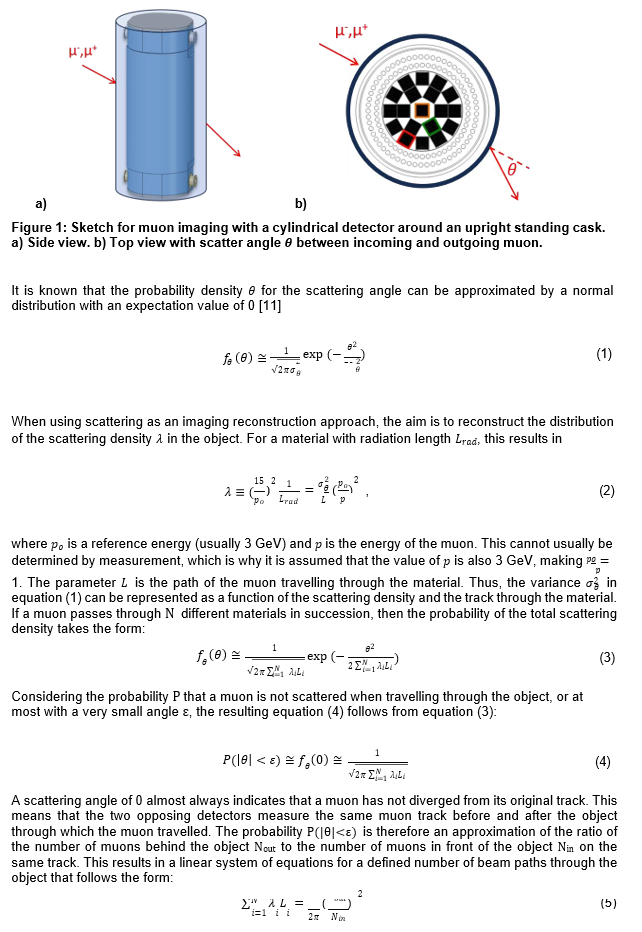
The scattering densities and lengths correspond to the pixels that are travelled through and thus along the beam path.
RESULTS
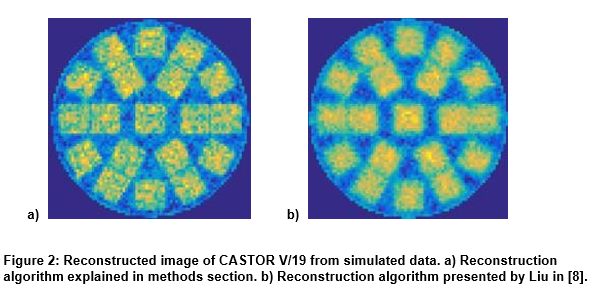
To test the resulting reconstruction algorithm, virtual measurement data was generated for the detector arrangement shown in Figure 1 using the Monte Carlo code program G4beamline [12]. The natural energy and directional spectrum of the cosmic muons was generated with the code from Chatzidakis [13]. A CASTOR V/19 cask with a homogeneous load was selected as the object of investigation and modelled in detail in G4beamline. There were 2×10⁷ muons simulated, twice incident on the surrounding detector. Depending on the altitude and surrounding structure of the object, this would correspond to a measurement time of several days in reality. The muons were combined into projections: 72 projections in 5° steps with a distance of 1 cm. The pixel resolution is also 1 cm. The reconstructed cross-sectional image of the cask inventory is shown in Figure 2a: the shape and position of the fuel elements are clearly recognizable. For comparison, Figure 2b shows the cross-sectional image that was calculated using Liu’s reconstruction algorithm [8] (in the article: Algorithm 1a). In this case, the scattering angle was used directly as projection data. The fuel elements are also clearly recognizable here. The image shows reduced noise, but also greater blurring, as the measured scattering angle is always influenced by the unknown path of the muon in the object. The algorithm developed here is able to generate a higher spatial resolution compared to others. The disadvantage, however, is that more statistical values are required.
CONCLUSION
Muons have been shown to be useful and suitable for imaging techniques, as demonstrated by several groups and studies, some referenced in this work. However, there is nevertheless potential for increasing the image quality of muon reconstructed images specifically by improving image reconstruction algorithms. Therein lies the open question: to what degree of resolution can these images be obtained? Is it possible, for example, to be able to discern a single rod from the hundreds or thousands within an interim storage cask? Presented here is a new method in which muon tracks were not estimated, but defined through a series of pathways and the ingoing and outgoing muons measured. Although this does require more data for statistical accuracy, the image is considerably sharper compared to other reconstructed algorithms. In continuing to develop this image reconstruction algorithm, hopefully even more highly resolved images can be obtained.
REFERENCES
[1] Hampel, U., Kratzsch, A., Rachamin, R., Wagner, M., Schmidt, S., Fiß, D. & Reinicke, S., “Investigations on potential methods for the long-term monitoring of the state of fuel elements in dry storage casks,” Kerntechnik, 83 (6), pp.513-522 (2018).
[2]
Wagner, M., Reinicke, S., Kratzsch, A., & Hampel, U.,“An analysis for detecting potential relocati on of the inventory of dry storage containers during prolonged interim storage via changes in the wall temperature fields,” Nuclear Engineering and Design, 366, 110749 (2020).
- Rachamin, R., Hampel, U., “Feasibility assessment of using external neutron and gamma radiation measurements for monitoring the state of fuel assemblies in dry storage casks,” Annals of Nuclear Energy, 135 (2020).
- Schultz,L., Borozdina, K., Gomeza, J., Hogana, G., McGill, J., Morrisa, C., Priedhorskya, W., Saundersa,A., Teasdalea, M., “Image reconstruction and material Z discrimination via cosmic ray muon radiography,” Nuclear Instruments and Methods in Physics Research Section A: Accelerators, Spectrometers, Detectors and Associated Equipment, 519(3), 687-694 (2004).
- Schultz, L., Cosmic Ray Muon Radiography, [unpublished dissertation], Portland State University (2003).
- Poulson, D., Durham et al., “Cosmic ray muon computed tomography of spent nuclear fuel in dry storage casks,” Nuclear Instruments and Methods in Physics Research Section A: Accelerators, Spectrometers, Detectors and Associated Equipment, 842, pp. 48-53 (2017).
- Vanini, S. et al., “Muography of different structures using muon scattering and absorption algorithms,” Philosophical Transactions of the Royal Society A, 377(2137), 20180051 (2019).
- Liu, , Chatzidakis, S., Scaglione, J. M., Liao, C., Yang, H., & Hayward, J. P., “Muon tracing and image reconstruction algorithms for cosmic ray muon computed tomography,” IEEE Transactions on Image Processing, 28(1), pp. 426-435 (2018).
-
Ancius, D., et al. Muon tomography for dual purpose casks (MUTOMCA) project. In INMM/Esa rda Joint Annual Meeting (2021).
- Braunroth, T., Berner, , Rowold, F., Péridis, M., & Stuke, M., “Muon radiography to visualise individual fuel rods in sealed casks,” arXiv preprint arXiv:2102.08131 (2021).
- Schultz, L., Blanpied, G., Borozdin, K., Fraser, A., Hengartner, N., Klimenko, A., Morris, C., Orum, C., Sossong, M., “Statistical Reconstruction for Cosmic Ray Muon Tomography,” IEEE Transactions on Image Processing, 16, pp. 1985-1993 (2007).
- Roberts, T. J., & Kaplan, D. M., “G4beamline simulation program for matter-dominated beamlines,” In 2007 IEEE Particle Accelerator Conference (PAC) (pp. 3468-3470). (2007, June).
- Chatzidakis, S., Chrysikopoulou, S., & Tsoukalas, L. H., “Developing a cosmic ray muon sampling capability for muon tomography and monitoring applications,” Nuclear Instruments and Methods in Physics Research Section A: Accelerators, Spectrometers, Detectors and Associated Equipment, 804, pp. 33-42 (2015).
ACKNOWLEDGEMENTS
This work was funded by the Federal Ministry for the Environment, Nature Conservation, Nuclear Safety and Consumer Protection (BMUV) with the grant number 1501661.
0 Comments