Dr. Bastian Weinhorst
Safetec GmbH Dischingerstr. 8, 69123 Heidelberg Bastian.weinhorst@safetec-hd.de
Dr. Tim Thomas, Dr. Edgar Perez Lezama, Iheb Meddeb, Michele Pastena
Safetec GmbH Dischingerstr. 8, 69123 Heidelberg
SUMMARY (max. 125 words)
The paper describes a study performed with the large clearance monitor (LCM) simulation software SIStec presenting a novel approach to take the contribution of natural occurring radioactive material (NORM) nuclides into account when analysing measurements by a large clearance monitor.
The approach utilizes two essential features of the SIStec software: the calculation of the efficiencies of the LCM detectors, and the activity localisation via an imaging algorithm.
The combination of these features allows an accurate estimate of the NORM contribution and consequently the residual activity due to contamination or activation of the material. By performing an analysis in accordance to regulatory norms the result can be used to calculate clearance sum values.
KEYWORDS
SIStec, clearance, activity, NORM
INTRODUCTION
The dismantling of nuclear power plants entails producing a large amount of material that has to be disposed of. Generally, the material is either sent to final repositories as nuclear waste, or released (under restricted or unrestricted conditions) as conventional waste.
In order to efficiently manage the large amount of waste packages produced during the decommissioning of a nuclear power plant, the release procedure must be sufficiently short and thus the measurement of the radioactivity of each single piece of waste needs to be optimized. To this end, large clearance monitors (LCM) are used to handle that challenging task. However, one major drawback to the release procedure is the long time needed for the sample preparation before one can measure its radioactivity and release it (e.g. the surface of metal waste must be flattened and cleaned before it can be scanned with a hand-held beta-sensitive monitor).
The key to make the clearance process more efficient is to reduce the complexity of each step of the process by removing conservative assumptions and as a consequence to have a more realistic analysis.
A crucial step in the preparation of the clearance measurement is the creation of sample calibrations,
i.e. estimating the calibration factors to calculate the amount of activity on the sample from the measured count rates. SIStec Basic provides an easy-to-use interface to perform complex Monte Carlo calculations for estimating the calibration factor for each detector of the LCM. The calculations are based on a model of the LCM, of the sample carrier and of the sample which can be created with ease in SIStec. By specifying a nuclide vector, the exact energies of the emitted gamma radiation from a nuclear decay are used for the calculation and a nuclide vector specific calibration is estimated. Due to its digital
nature all parameters in the calculation can be easily varied to perform a parameter study to estimate the effect of a deviating parameter (e.g. mass, density, nuclide vector composition).
The key to make the clearance measurement itself quicker lies on the fact that each LCM has detectors distributed over the full 4π solid angle: applying state of the art statistical imaging in SIStec Pro [1] one can partition the waste into small virtual blocks whose activity can be estimated. Utilizing the Monte Carlo approach for propagating uncertainties, the characteristic limits necessary for the clearance of sample material are calculated in accordance to DIN EN ISO 11929 [2]. The approach used in SIStec Pro removes the overly conservativity which assumes that entire sample activity is located in the point of worst efficiency. This is achieved by simply localizing the activity in the sample and using the real efficiency for the calculation of the characteristic limits. In addition, the imaging of the activity removes the time-consuming work to prove a homogeneous activity distribution by manual measurements with a handheld contamination monitor by simply measuring the real activity distribution over the sample.
In the case that the sample itself contains natural occurring radioactive material (NORM) as in the case of concrete, the power of the combination of the abilities of SIStec Basic, to calculate the detector efficiencies for different gamma radiation energies, and SIStec Pro, to take the NORM nuclides into account when calculating the characteristic limits, is shown.
In this paper we discuss a novel approach to take the contribution of NORM nuclides into account when analysing a measurement with the SIStec Pro software. We start with a description of the approach in section 2 and discuss the obtained results in section 3 before we conclude in the final section.
Removing the contribution of NORM from LCM measurements
The activity in the sample is calculated using an imaging algorithm based on the maximisation of the Informational Conditional Entropy [3] (Conditional Entropy Maximisation or, from now on, CEM). For this the sample is partitioned into small virtual cells and the activity for each of the cells is estimated. The model of evaluation in use cannot be written in a simple form, as it uses an iterative approach to maximize the entropy. Nevertheless, in equation (1) a basic form of the model of evaluation is given. The only simplification is that the calculation of the activities 𝑎𝑖 from the input parameters is shown as an arrow.

The specific activity 𝐴𝑁𝑜𝑟𝑚 of the NORM nuclides needs to be measured by a gamma-spectrometric measurement which determines the specific activity of K-40 and of the decay chains of Th-232 and Ra- 226 in order to define the NORM nuclide vector in the best way possible. For this source the specific activity 𝐴𝑁𝑜𝑟𝑚 including its uncertainty 𝑢(𝐴𝑁𝑜𝑟𝑚) is then estimated based on the performed spectrometric measurements. The nuclide vector defines a gamma source which contains all gamma-lines of both decay chains assuming that the daughter nuclides are in equilibrium.
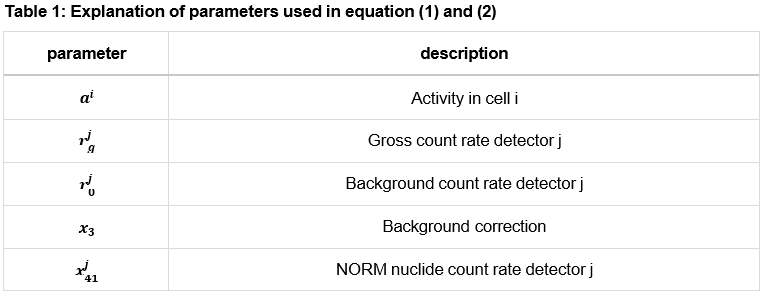
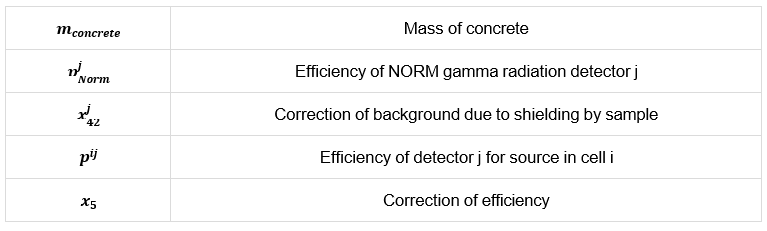
Thanks to SIStec Basic, it is possible to show that the contribution of K-40 to the total natural radioactivity is in general of the same order of magnitude of Th-232 and Ra-226 and their decay chains. This means that the contribution of Th-232 / Ra-226 and their decay chains cannot be neglected, even though the relevance of each single gamma line is much smaller to K-40 alone.
Analysis results and localisation
Case I: Contaminated concrete block
A dummy sample for a concrete block was created with a size of roughly 60 x 50 x 35 cm³ and a weight of 174 kg. A Co-60 point source of 5350 Bq was placed into the side of the block. SIStec estimated the activity to be 5797 Bq and located the activity at the correct position (see Figure 1)
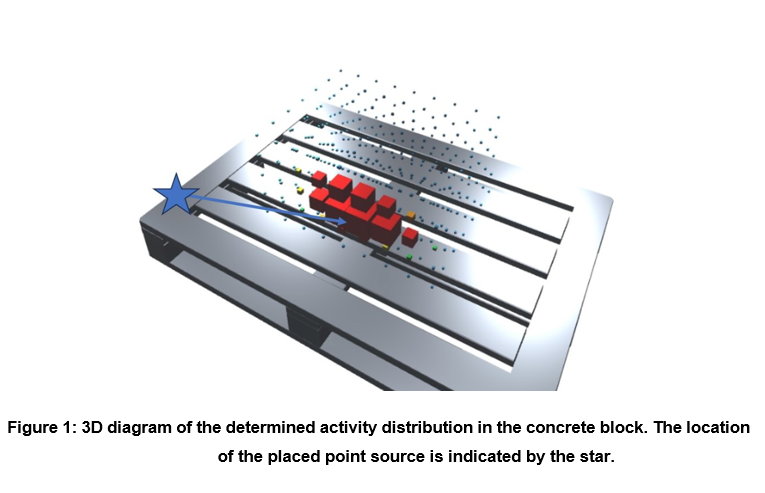
The analysis was done assuming that only a superficial contamination on the concrete block was present. The SIStec Pro algorithm took this information into account and only placed activity in the superficial cells of the concrete block.
Measuring the same dummy sample without placing any source into it results in an estimated Co-60 activity of 270 Bq indicating that the contribution of the NORM nuclides where not fully accounted for. It also shows clearly that the differences found between the placed and estimated activity in the first measurement originate from the residual NORM contribution. The most significant factor contributing to the underestimation of the NORM contribution was the performed gamma-spectrometric analysis. It was performed directly after taking the sample from the concrete which did not allow the decay chains to reach equilibrium again after gaseous decay products outgassed from the concrete. Storing the sample for a while in e.g. a Marinelli beaker for airtight storage and optimal geometry for the spectrometric measurement would have yielded a slightly higher result for the NORM contribution.
Case II: demolition waste
A second dummy sample was created resembling a Big Bag filled with concrete rubble. With a size of 100 x 70 x 35 cm³ and had a weight of about 500 kg. Inside this dummy, three Cs-137 sources of different magnitude (24400 Bq, 497 Bq, 683 Bq) were situated in different places of the dummy.
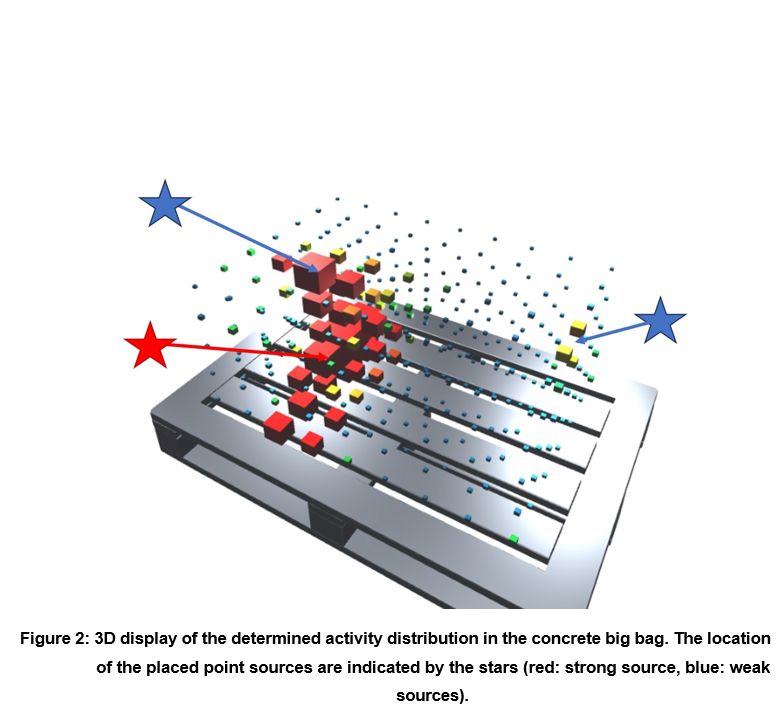
The result (see Figure 2) shows that the strong source in the centre of the big bag can be separated from the weak source on the right side. A separation of the weaker source on top of the big bag was not achieved due to is relative closeness to the strong source. In total the activity was correctly estimated within the bounds of uncertainty with the upper bound to be at 28800 Bq.
CONCLUSION
The SIStec software was used to perform a study on the contribution of NORM nuclides to LCM measurements. Starting with the creation of several dummy samples (virtually and real for validation measurements) and performing a parameter study by calculating detector efficiencies for these samples the base was prepared for the extended analysis.
In the paper a novel approach for taking the contribution of NORM nuclides into account during the analysis of LCM measurements was presented. The focus was given to not only remove the contribution from K-40 but also taking into account the gamma radiation originating from NORM nuclides in the decay chains of Th-232 and Ra-226. The cumulative effect of the two decay chains was found to be of the same order as the contribution of emitted radiation from the decay of K-40. Taking into consideration only K-40 would therefore have resulted in a strong underestimation of the NORM contribution.
Applying the imaging algorithm from SIStec Pro allowed the calculation of the activity distribution which was located on the surface of the concrete dummy, causing the conservative assumption of where the activity is and how it is distributed to become obsolete. In addition, the contribution of the NORM nuclides was correctly being accounted for and therefore allowing to determine the quantity of the placed activity sources.
The shown results for surface activity or volumetric activity can directly be used for calculating clearance sum values. The new approach demonstrates great benefits for clearing material when compared to the standard approach of assuming only K-40.
REFERENCES
- Pastena et.al., “A novel approach to the localization and estimation of radioactivity in contaminated waste packages via imaging techniques,” Measurement Science and Technology, Volume 32, 095401 (2021).
- DIN ISO 11929:2021, Bestimmung der charakteristischen Grenzen (Erkennungsgrenze, Nachweisgrenze und Grenzen des Vertrauensbereichs) bei Messungen ionisierender Strahlung
– Grundlagen und Anwendungen (ISO 11929:2021),“ Beuth Verlag GmbH, 2010
- Cover M., Thomas J.A., Elements of Information Theory, Wiley, 1991
0 Comments