Tanzila Nurjahan
Institut für Energietechnik,
Technische Universität Dresden,Germany t.nurjahan@hzdr.de
Felipe de Assis Dias
Experimental Thermal Fluid Dynamics,
Helmholtz-Zentrum Dresden Rossendorf, Dresden, Germany f.dias@hzdr.de
Eckhard Schleicher
Experimental Thermal Fluid Dynamics,
Helmholtz-Zentrum Dresden Rossendorf, Dresden, Germany e.schleicher@hzdr.de
Uwe Hampel
Institut für Energietechnik,Technische Universität Dresden,Germany, Experimental Thermal Fluid Dynamics, Helmholtz-Zentrum Dresden Rossendorf, Dresden, Germany
SUMMARY
During the decommissioning of nuclear power plants (NPPs), there is concern about residual contamination, particularly in the concrete structures of the containment sump. The shell-like structure of the sumps and the inherent porosities including cracks, and construction joints of the concrete can exacerbate the problems by potentially retaining contaminated moisture. Measurement of contaminated moisture in 2 to 3-cm diameter of concrete boreholes is a challenge; however, electrical impedance spectroscopy (EIS) appears to be worthwhile in this context. EIS is a non-destructive method of measuring moisture content (MC) by analyzing the changes in electrical impedance upon applying different frequencies of electrical potential. Our approach can determine MC with an accuracy (coefficient of determination) of 94%, which is in excellent agreement with experimental results with a measurement uncertainty of less than ± 0.5% in most cases.
KEYWORDS
Decommissioning, electrical impedance spectroscopy (EIS), capacitance and permittivity, concrete
moisture content
INTRODUCTION
One of the biggest challenges in decommissioning NPPs is dealing with the mere amount of radioactive waste generated during power operation peridod. Concrete accounts for nearly 40% of that material. Depending on the nuclear safety zone, the concrete must initially be regarded as radioactively contaminated per se, regardless of the actual contamination with relevant radionuclides. Concrete masses are allowed to be discharged out of the controlled area if radiological clearance limits are not exceeded. However, the amount of concrete structures in the spherical reactor building and the annular space is huge and the treatment during the dismantling process is exhausting. When an NPP is finally
shut down, the reactor is no longer in operation, however, the basic safety functions of subcriticality, heat removal and activity maintenance remain. This known as post-operational phase can last for several years and ends with the authorisation of the operator for the decommissioning and dismantling of the NPP [1]. The dismantling of concrete structure is carried out at a much later stage of the decommision process. Beforehand, the reactor building will be emptied of any loose high-level radioactive material such as the primary coolant system, tubes, huge components such as steam generators, pressurizer, hydro accumulators and several pumps. Before entering the stage of dismantling of concrete structure, better understanding and anticipatory analytics of concrete volume districts holds great potential for reducing this waste amount. The distinction between radioactive and non-radioactive areas becomes a cost-determining factor when the radioactive nuclide penetrates deep into the concrete structures. It is therefore important to distinguish clearly between the two before decommissioning of concrete structures begins [2].
Determination and mapping of the contamination is done according to the current state of the art by core drilling and laboratory analysis of the core material. However, lack of accessibility, structural constraints and cost limit the number of sampling boreholes. An alternative to core drilling is core-less drilling into the solid body. With narrow boreholes, significantly more boreholes can be drilled without endangering the structural integrity. Since this drilling method no longer provides cores for analysis; a new measurement and analysis techniques must be developed. The project “KOBEKA” focuses on this issue, both from a fundamental scientific point of view in a laboratory scale and on-site in a German nuclear power plant. One of the new measurement and analysis techniques inside KOBEKA is the in-situ moisture measuring.
RADIOACTIVITY IN CONTAINMENT CONCRETE
The decommissioning of NPPs is a comprehensive, complex industrial and technological process. Years of work are required to prepare and carry out the entire process. During the decommissioning of NPPs, there are concerns about residual contamination, particularly in the concrete structures of the containment. The activation and contamination in the containment building essentially affects three different areas of concrete in the NPPs:
- The biological shield of the reactor and the underlying concrete structures: These are the most activated and associated with highly radioactive waste (class III).
- Spent fuel pool: Due to damage to the steel lining, contaminated water from the spent fuel pool can penetrate deep into the concrete structure.
- Sump system leaks in the dome: The most common source of contamination is leakage of primary cooling water from different systems. Such leaks and releases of contaminated water are not critical and do not pose a safety They occur over the years and are sometimes unavoidable, e.g. when emptying filled pipe system for inspection of flanges or valves during outages and refueling.
Furthermore, the structure of the reactor building is designed such that the maximum amount of spilled water during a loss of coolant accident (LOCA) reaches the south pole of the spherical structure known as the sump or calotte, which is comparable in shape to a lower shell (Figure 1). A LOCA never occurred, however due to that design each amount of water leakage tends to be accumulated in the calotte and the probability of contamination penetrating deep into the concrete is high. The activation and the presence of deeply penetrated contaminations in concrete structures can be particularly challenging. Activation is predictable due to the physical relationships and can be reliably determined by sampling/measurement of the structure, however, the penetration of contaminants into the concrete is much more difficult to assess.
THE STATE OF THE ART AND THE RESEARCH TO DATE
In 2014, a sampling of concrete was initiated at the Stade NPP (KKS) after liquid leaked from the concrete/steel interface at a newly created breakthrough duct widening the pipe penetration of the emergency core cooling system through the containment; and deeply penetrating contamination was found in the containment sump. Liquid contamination was found in all core holes in the containment head during sampling of the concrete structures. Root cause analysis indicated that primary coolant had been leaking into the containment sump area during operation as evidenced by the presence of boron compounds. This investigation provided an opportunity to critically review the sampling methods, procedures and actions. Contaminated water ingress transpires primarily along construction joints between concrete components, however, also at interfaces between concrete matrix, formwork integrated with components, and through cracks. It is assumed, construction joints behave similarly to
capillaries and cracks in concrete, which can absorb water very quickly. It is therefore important to consider both the degree of contamination and the location of the construction joints during sampling. The penetration behaviour of radionuclides into unprotected concrete structures and, alternatively, the release behaviour from concrete and rubble during the decommissioning of a plant has already been investigated by the VKTA, where contamination is identified and mapped using state-of-the-art laboratory analysis of the core drilling samples [3, 4]. However, sampling is limited by difficult site access, structural constraints and cost. An alternative is the twist coreless drill, produces a much slimmer hole than conventional coring, which allows a much greater number of holes to be made without unacceptable weakening of the structural integrity of the reactor building and laboratory analysis. Due to the lack of a drilling core for analyses, it is therefore necessary to develop new measurement technique to map and identify the contaminated concrete areas during decommissioning of NPPs [5, 6].

The idea of the KOBEKA project is to develop an innovative measurement technique for sampling and mapping the contaminated concrete areas in the containment, funded by the German Federal Ministry of Education and Research (BMBF) as part of the FORKA program (research for the decommissioning of nuclear facilities). The project includes gamma spectroscopic measurements, laser-based analyses, the investigation and modelling of permeability, sorption and radionuclide transport in narrow boreholes in the containment structure. One of the ideas of this work is therefore to develop a simple and cost- effective measurement system by introducing a new in-situ measurement technique for the determination of moisture and porosity in small, slender boreholes of only 2-3 cm diameter where the knowledge of moisture content (MC) will provide an indication of primary coolant ingress.
MEASUREMENT OF MOISTURE CONTENT IN CONCRETE
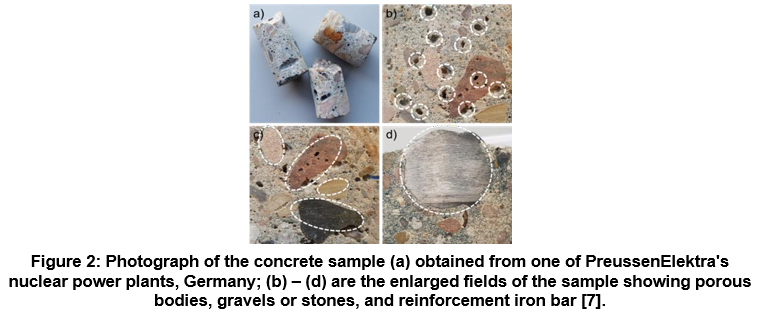
Concrete is a complex matrix typically consisting of cement, sand, reinforcement iron, aggregates and porous bodies (Figure 2). Due to its poor electrical conductivity, dry concrete is considered as dielectric material. The dielectric constant (εr) of dry concrete is typically in the range of 4 to 7. However, introducing moisture into the structure changes the overall material properties and a significant effect is observed in moist concrete with εr between 8 and 16.
However, moisture in NPPs, especially in the containment, is key to identifying potentially contaminated areas, as the overall performance of the concrete properties changes simply due to the water ingress, whereby the εr of water is around 80. Therefore, accurate assessment and mapping of concrete in containment building is essential to understand the influence of concrete agglomerates, especially MC, porosity, cold-joints [7]. For the characterization of the concrete properties, electrical impedance spectroscopy (EIS) was used in this work as a sensitive moisture measurement technique due to its non-destructive nature and adaptability.
PRINCIPLE OF ELECTRICAL IMPEDANCE SPECTROSCOPY (EIS)
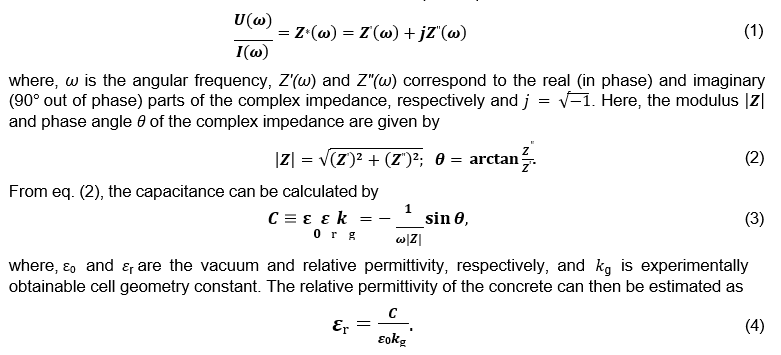
Characterization of concrete using EIS is typically carried out by connecting two electrodes to a concrete sample. An electrical stimulus (current or voltage) is applied to the electrodes and the response (resulting voltage or current) is measured. From applied current and measured voltage (or vice versa), Ohm’s law can be used to determine the concrete’s complex impedance as
EXPERIMENTAL SETUP
Containment concrete has a rough surface due to the inherent heterogeneity of agglomerates with sand- cement mixture, air voids, capillaries and uneven aggregate size with maximum visible diameter of 5 cm. Drilling 2 meters along core holes can alters the surface structure and can even cause deterioration of the concrete within the hole. In addition, the variation in size of the hole along its length is affected by the erosion diameter of the drilling process; in fact, the hole itself shows the inhomogeneity. Due to the heterogeneous concrete structure, measurement of the MC in the drilled hole is challenging. The larger aggregate sizes must be considered, otherwise the dry zone may be mis-measured, as aggregates are not usually absorbent and properties are not greatly altered by water exposure. Considering all these factors, a lance (with mounted camera on top) solution with proper electrode arrangement is proposed that is optimal for detecting the MC of concrete in a rough surface within a borehole compared to the conventional state-of-the-art process (drilling core and laboratory analysis).
The aim of this study is to develop an innovative and cost effective measurement technique to investigate contaminated moisture in slender boreholes in containment building. To achieve this, the investigations were carried out using EIS to determine the MC of concrete under laboratory conditions. To this end, an experimental set-up was developed using a Sciospec impedance analyzer (ISX-3). The impedance of the sample was measured over a range of frequencies from 10 Hz to 10 MHz and the data were recorded at 50 different points on a logarithmic scale with a relatively low signal amplitude of 250 mV. The measurements were carried out in a laboratory with controlled temperature and humidity. Prior to the measurements, the obtained sample from one of PreussenElektra’s NPPs, was cut into pieces with a thickness of 10 mm. It was then immersed overnight in deionized water (conductivity of 4.0 µS/cm) until complete saturation. Once the sample was removed from the water, its surface was dried and placed intimately in between the sensor [7]. To determine the moisture of the concrete, a gravimetric MC in percent (%) was calculated using the wet (w1) and dry (w2) sample masses according to the following relationship, and a scale was used to determine the concrete weight,

RESULTS
STUDY THE INFLUENCE OF MC (%) ON CAPACITANCE AND RELATIVE PERMITTIVITY
The impedance of the concrete sample is experimentally investigated at various moisture levels and the influence of MC is analyzed (Figure 3a). A double logarithmic plot illustrates the nonlinear capacitance behaviour and shows a step transition separating two plateaus over the frequencies between 101 and 108 (rad×s-1). A sharp decrease at very low frequencies (up to 103 rad×s-1), and then a gradual decrease of capacitance is observed when the frequency reaches to high (after 103 to 107 rad×s-1).
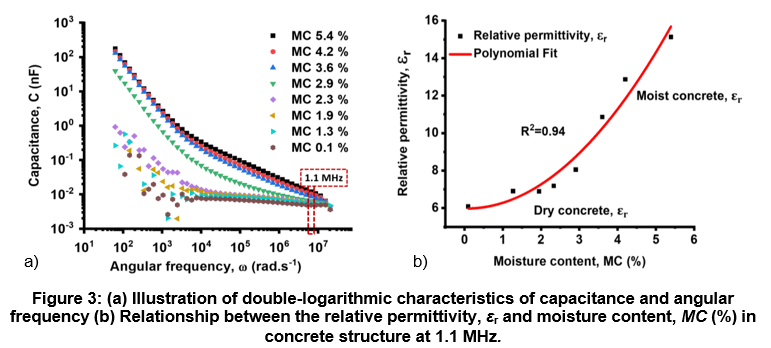
At low frequencies, concrete polarization increases due to easier electron migration and charge accumulation at the concrete interfaces (interface polarization) and sensor electrode (space charge polarization), resulting in relatively high capacitance, >102 nF (Figure 3a). However, at higher frequencies (ω > 107 rad×s-1), capacitance decreases due to slower carrier relaxation, influence of internal structural composition and/or external resistance. Moisture is an important factor influencing concrete capacity, as the permittivity of moisture is much higher than that of the solid phases of concrete. At lower MC (2.3% to 0.1%), the concrete is relatively dry and εr is primarily determined by the solids (aggregate and paste), resulting in a relatively low capacitance (< 1 nF). However, due to the presence of water, which has a much higher εr of ~ 80 than the solid constituents, the concrete capacitance increases, >102 nF with the increase of MC (2.9% to 5.4%).
However, for a better understanding of the influence of moisture, εr, has been plotted as a function of MC (%) (Figure 3b). At lower MC, it is evident, εr belongs to dry concrete, however, at higher MC a gradual increase in εr is observed as the water molecules begin to occupy the concrete pores, reflecting the increasing influence of MC on the concrete matrix. A single frequency of 1.1 MHz was chosen to analyse the MC (Figure 3b), is high enough to minimise the influence of stored water conductivity and low enough to suppress the inductive effects. Meanwhile, the signals being measured should cover a sufficiently wide dynamic range to provide a good SNR. However, the dynamic range is not large enough that the complexity of the circuitry increases enormously. At a frequency of 1.1 MHz (Figure 3b), εr increases as a 2nd order polynomial and the fitted model provides an adequate prediction of the MC of the concrete. The predicted fit coefficient reached a value of R2 = 0.94, which is quite encouraging for moisture determination using EIS technique.
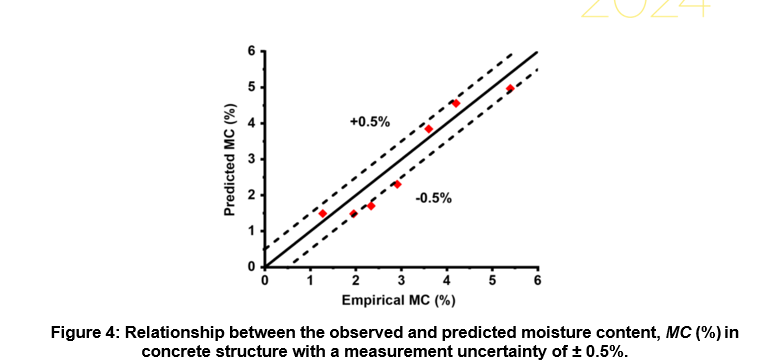
In order to validate the results obtained from the experiment, the relationship between the measured and the predicted MC (%) was plotted as a parity plot (Figure 4). The fitted model was found to predict the MC with ± 0.5% of the measurement uncertainty, indicating that EIS is a suitable technique for the measurement of MC in inhomogeneous concrete structure. This non-destructive approach (EIS) will improve the decommissioning process by ensuring an optimal moisture measurement technique for the management of the risk of the contamination of radioactive elements/ materials during the dismantling of NPPs, while protecting public health and the environment.
CONCLUSION
In this work, the electrical properties of concrete have been experimentally investigated at various MC. The conclusions of this study are the following: (1) Capacitance increases proportionally with MC; thus a 2nd order polynomial fit was proposed for the prediction of MC in concrete, which was in very good agreement with the experimental results with an adjacent R2 of 0.94. (2) At the frequency of 1.1 MHz, the measured εr is in absolute agreement with the literature for both dry (4-7) and wet (8-16) concrete, validating the reliability of the measurement technique and results. (3) The accuracy of the EIS for the measurement of MC is very well quantified by the parity plot with a measurement uncertainty of ± 0.5%.
OUTLOOK
The potential of EIS for concrete moisture analysis is promising. By incorporating advanced models for electrical circuit elements and lance design, EIS could therefore enable accurate and efficient monitoring of roughness, cracks, and especially cold joints in concrete in future work.
REFERENCES
- “ENGIE Electrabel,” https://nuclear.engie-electrabel.be/en/nuclear-energy/major-nuclear- projects- belgium/decommissioning (2023).
- Diedenhofen, et al., “Development of a · decontamination process for radioactively contaminated and activated concrete from dismantled nuclear power plants by activity separation,” RWTH Aachen University and Siempe/kamp Nukleartechnik GmbH, Krefeld, Department of Mineral Processing, Germany (total decomm. Cost explained).
- BMBF 1999, “Stilllegung und Rückbau: Eindringverhalten radioaktiver Kontamination in ungeschützte Betonstrukturen,” Abschlussbericht zum BMBF-Vorhaben 02S7605A, April (1999).
- BMBF 2007, “Verbundprojekt Kontaminierter Beton: Rückbau kerntechnischer Anlagen – Eindringen von Radionukliden in Betonoberflächen und Freisetzung eingedrungener Aktivität aus Bauschutt und Beton,” Abschlussbericht zum BMBF-Vorhaben 02S7910, Mai (2007).
- Klein, , “Auswirkungen einer in Betonstrukturen eingedrungener Kontamination am Beispiel der Betonkalotte im Sicherheitsbehälter (SHB) des Kernkraftwerk Stade (KKS),” 7. TÜV Nord Symposium, Stilllegung und Rückbau Kerntechnischer Anlagen, Hannover, Germany (2016).
- Schröfl, Ch. Et al., “Assessment of in-fact contaminated concrete inside nuclear power plants to reduce waste amounts after decommissioning,” 49th WM Symposia, Phoenix, USA (2023).
- Nurjahan, et al., “AC impedance spectroscopy to characterize the dielectric material properties in concrete during decommissioning of nuclear power plants,” 98th IEEE Conference on Electrical Insulation and Dielectric Phenomena (CEIDP), East Rutherford, NJ, USA (2023).
ACKNOWLEDGEMENT
The project on which this publication is based is funded by the German Federal Ministry of Education and Research (BMBF) under grant number 15S9434A. The responsibility for the content of this publication lies with the author.
0 Comments