Jens Pauluhn
GNS Gesellschaft für Nuklear-Service mbH Frohnhauser Straße 67 jens.pauluhn@gns.de
Robert Schneider
GNS Gesellschaft für Nuklear-Service mbH Frohnhauser Straße 67 robert.schneider@gns.de
SUMMARY
The dual-purpose CASTOR® casks – designed, licensed and manufactured by GNS Gesellschaft für Nuklear-Service mbH – is well-established with more than 40 years of continuous evolution and improvement. Due to increasing customer demands, GNS developed a new cask family, CASTOR® geo, for the global market. The CASTOR® geo cask family offers a wide range of applicability for fuel assemblies (FA) from pressurized (PWR) and boiling water reactor (BWR).
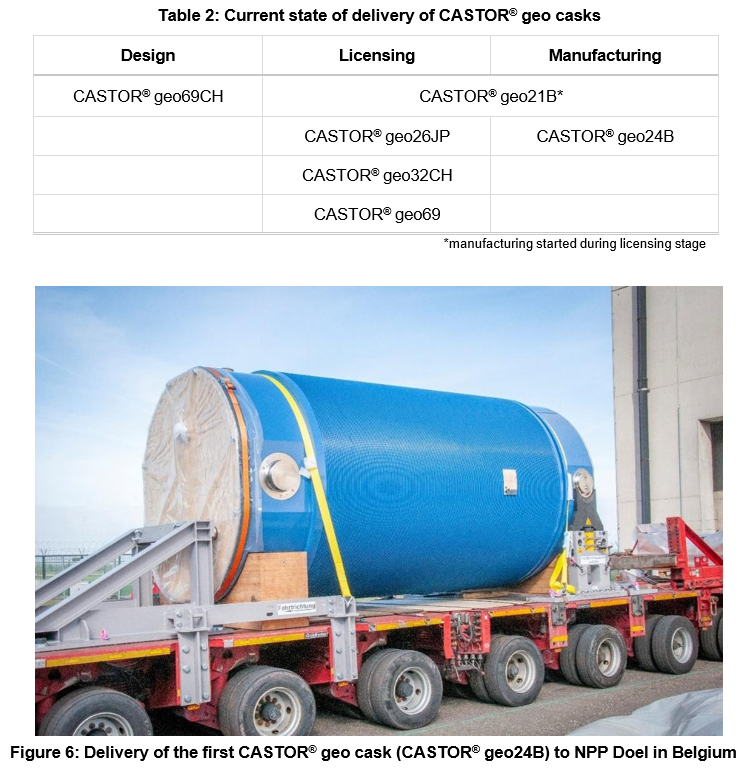
Two cask types of the CASTOR® geo family are already in manufacturing (CASTOR® geo21B, CASTOR® geo24B) with one of the CASTOR® geo24B casks already being delivered to the customer. Cold trials have been finished with the first cask so far, hence processing and loading with FA will start in a short time. Further cask types follow consecutively with CASTOR® geo69, CASTOR® geo26JP and CASTOR® geo32CH being in licensing process and CASTOR® geo69CH in design stage.
In this paper the suitability of the CASTOR® geo cask family for the transport and storage of spent nuclear fuel using an efficient design philosophy, is demonstrated by highlighting several licensing and experimental testing aspects.
KEYWORDS
CASTOR®, geo, thermal load test, missile test, drop test
INTRODUCTION
GNS Gesellschaft für Nuklear-Service mbH is a German manufacturer of dual-purpose casks and is owned by the German utilities PreussenElektra, RWE, Vattenfall and EnBW. As their competence center for spent fuel and nuclear waste management, GNS is responsible for the entire life-time cycle of spent FA and high level waste (HLW), from the design and manufacturing of transport and storage casks, to their loading, subsequent transport and storage. GNS is the inventor and developer of the well- established CASTOR® casks, the world’s first dual-purpose casks for spent fuel. The very first CASTOR® cask for long-term interim storage, which is still in safe storage at the Swiss interim storage facility ZWILAG today, has been loaded in 1983.
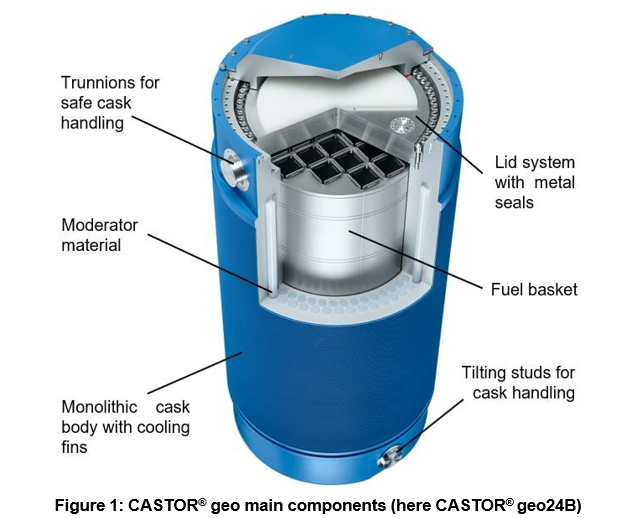
The cask body of CASTOR® casks is made of ductile cast iron (DCI). This ensures the necessary gamma shielding and the integrity of the leak-tight enclosure of the FA. For a further improvement of the shielding capability, neutron moderator material is used in the cask wall, as well as on the top and bottom side of the cask. The casks are equipped with a multi-lid sealing system which allows a permanent monitoring of the leak-tightness during the interim storage period.
Facing the demand of higher FA capacities per fuel basket/cask, GNS developed the new CASTOR® geo cask family. Relying on the well-proven CASTOR® concept, the CASTOR® geo cask system offers a wide range of application for disposal of PWR and BWR FAs due to its modular setup.
THE MODULAR CASTOR® geo CONCEPT
The CASTOR® geo cask system relies on over 40 years of experience with the well-proven and continuously improved CASTOR® technology. All main features of CASTOR® casks are also applied in the CASTOR® geo design. The materials used are mainly based on the CASTOR® V design, improved over decades of experience. The main design features are shown in Figure 1:
The different cask types of the CASTOR® geo family are standardised in several main design features to enable good synergies which also helps in terms of licensing processes due to same methodology and major parts of safety cases being unchanged. The standardisation comprises
- cask cavity diameter,
- impact limiter design,
- selection of materials,
- component design and
Due to this, major benefits like shorter development and licensing process durations without compromises regarding robustness of the design can be achieved, thus resulting in cost efficient casks. Nevertheless, the individual requirements of customers worldwide (for example: regarding handling and processing of the cask or design of the cooling fins) can be considered by tailor-made modifications.
The following characteristics shows the variety of applications of the CASTOR® geo cask system:
- Customizable fuel baskets with up to 32 PWR-FA or 69 BWR-FA
- Maximum enrichment of 5 wt-%
- Burnup up to 74 GWd/MTU
- Optional MOX fuel capabilities
THE CASTOR® geo CASK SYSTEM
As already introduced, the CASTOR® geo cask system is widely useable and an essential part of the current projects ongoing at GNS. This chapter provides an overview of the CASTOR® geo cask designs, which are already licensed, in manufacturing, in the licensing process or in the design stage. These casks are shown in Figure 2:
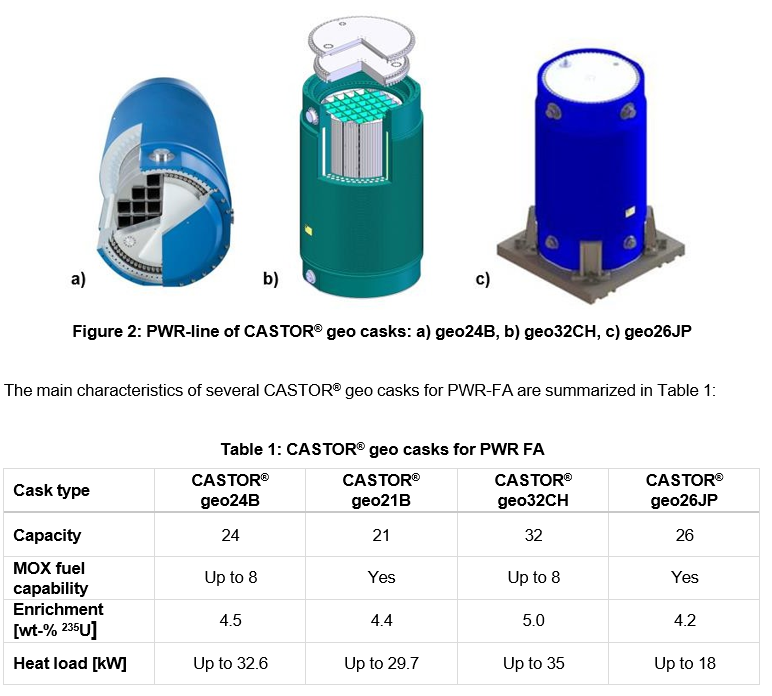
Also, CASTOR® geo casks for storage of BWR-FA are already in design stage and licensing process to cover the needs of BWR nuclear power plants (NPP), namely the CASTOR® geo69 with ongoing licensing in the USA and the CASTOR® geo69CH cask for Switzerland.
EXPERIMENTAL TESTING
The CASTOR® geo cask system is based on the already well-validated CASTOR® cask technology, for which numerous experimental tests have been performed over many years to fulfill the requirements of several competent authorities of specific countries, of specific customer demands or by GNS itself to gather necessary experience in material behaviour or to validate the application of different construction codes.
For CASTOR® geo cask designs, several tests have additionally been performed to demonstrate conformity with the design requirements, reliability and resilience against severe accident scenarios.
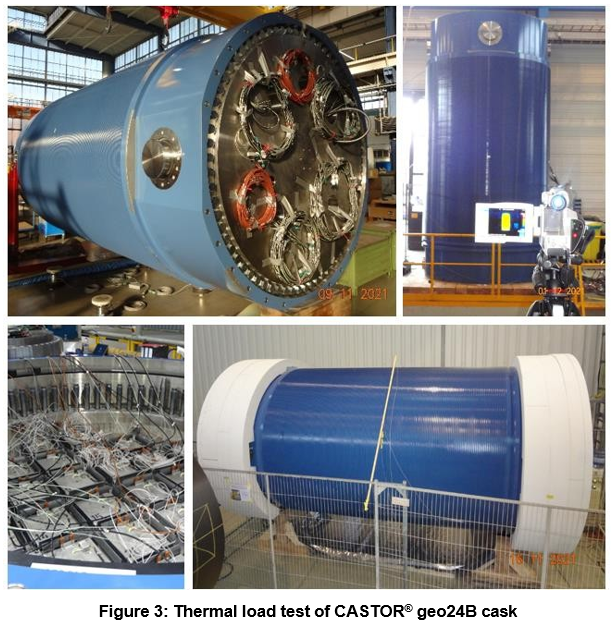
For validation of thermal calculation models, a thermal load test was conducted on the first manufactured CASTOR® geo cask (namely: CASTOR® geo24B) to simulate and validate the heat transfer both in transport and storage configuration. The cask was equipped with special lids and dummy impact limiters, specifically made for this testing purpose. 24 heat dummy FA have been inserted into the fuel basket. Then, the cask was heated up to its design heat load of 32,6 kW. Temperature monitoring was assured by more than 40 sensors, in- and outside of the cask. Afterwards, the recorded data was compared to numerical calculations and the conservativeness of the numerical results was confirmed.The entire duration of the thermal load test in both configurations was several weeks.
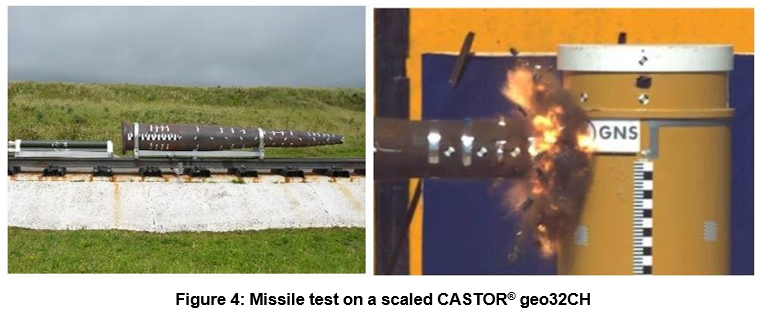
Furthermore, a missile test was performed: A scale model of a CASTOR® geo cask was used to simulate the storage accident scenario of an aircraft impact onto the cask. For this purpose, the projectile design was derived in advance from a sensitivity study based on finite element simulations to reflect the required load-time-curve. This design was confirmed by additional testing and before performance of the final test. Finally, the projectile was shot onto the scale model of the CASTOR® geo cask with pin-point accuracy onto the specified spot (side impact, see Figure 4). The impact also fulfilled the expectations with regard to impact velocity, projectile behaviour and cask kinematics.
After retrieval of the cask from the debris of both the projectile and the catch structure, the cask integrity as well as the leak tightness of the lid system were verified by helium leak-tightness testing. The determined leak rate undercut the permissible value by three orders of magnitude. Thus, the reliability of the cask in this severe accident scenario was demonstrated successfully.
To prove conformity with the IAEA regulations, two scaled drop tests (9 m drop and subsequent pin drop test from a height of 1 m) have successfully been performed at the drop-test facility at Lichtenau (Germany), operated by IABG. Afterwards, the cask integrity as well as the leak tightness of the lid system were proven by performance of helium leak-tightness testing.
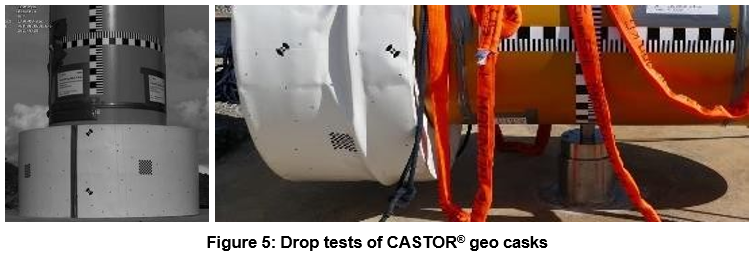
Thus, robustness of the CASTOR® geo cask system against these accident conditions of transport was demonstrated by experimental testing.
CURRENT STATE AND OUTLOOK
Table 2 provides an overview of the current project phases of the various CASTOR® geo projects, while the delivery of the first CASTOR® geo cask in May 2022 to NPP Doel is shown in Figure 6:
CONCLUSION
To meet the demands of the international market for high capacity cask types, GNS started the development of the CASTOR® geo cask system. Today, this system forms an already well established cask family, whose usability, robustness and flexibility has been successfully demonstrated.
From design stage over licensing process to manufacturing and subsequent loading of CASTOR® geo casks, GNS is ready for future challenges to provide a reliable and state-of-the-art high capacity cask dry storage system worldwide.
0 Comments