Eric Rentschler
Karlsruher Institut für Technologie, TMB Karlsruhe, Gotthard-Franz-Str. 3 eric.rentschler@kit.edu
Sascha Gentes Stefan Stemmle Johannes Greb Martin Villinger Kurt Heppler
Karlsruher Institut für Technologie, TMB Karlsruhe, Gotthard- Franz-Str. 3
SAT Kerntechnik Gmbh Robur Group
Worms, Am Guten Brunnen 10
Contec Maschinenbau GmbH
Alsdorf, Hauptstraße 146
HTWG Konstanz Maschinenkonstruktion Konstanz, Alfred- Wachtel-Straße 8
HTWG Konstanz Maschinenkonstruktion Konstanz, Alfred- Wachtel-Straße 8
Sascha.gentes@kit.edu Stefan.stemmle@robur-
group.com
greb@contecgmbh.com m.villinger@htwg-
konstanz.de
Kurt.heppler@htwg- konstanz.de
SUMMARY
To be able to dismantle nuclear power plants after decommissioning, all surfaces must be decontaminated before conventional demolition. It is not the large and easily accessible surfaces that cause difficulties in decontamination, but the poorly accessible corners and inner edges. To be able to decontaminate these areas, hand-held tools are currently being used, which have been originally developed for conventional dismantling. To ensure occupational health and prevent contamination carryover, these devices need an external extraction system. As a result, the output is reduced and hard-to-reach areas are even more difficult to reach. These factors make these decontamination tasks a major challenge for the workers. In order to make this work easier and more efficient, the EKont research projects were launched.
KEYWORDS
Decontamination, Dismantling, Nuclear waste reduction, Concrete Demolition, Inner Edges & Corners
INTRODUCTION
The research projects Ekont (Development of an innovative, semi-automated demonstrator for dry- mechanical decontamination of corners, edges and impurities for nuclear facilities, FKZ: 15S9416A) and EKONT-2 (Advancement of a demonstrator for dry-mechanical decontamination of corners and inner edge in nuclear facilities, FKZ: 15S9440B) were funded by the German Federal Ministry of Education and Research (BMBF) as part of the FORKA program of GRS. The projects are collaborative projects between Contec Maschinenbau & Entwicklungstechnik GmbH, SAT Kerntechnik GmbH, HTWG Konstanz MA and the Karlsruhe Institute of Technologie – Institute of Technology and Management in Construction – Department for Deconstruction and Decommissioning of Conventional and Nuclear Buildings.
THE EKONT-PROJECTS
Decontamination is an important part of dismantling nuclear structures. This involves removing all radioactive contamination. As standard, the surfaces to be decontaminated per nuclear power plant range between 100,000m² and 450,000m², which have to be decontaminated and then cleared by measurement. Concrete components are usually decontaminated by removing the surface to the depth at which contamination is no longer present. Interviews with dismantling companies and nuclear power plant operators have shown that corner and inner edge decontamination in particular has so far been carried out using hand-held equipment. Tools such as needle guns, stick and grinding devices are state of the art. These devices were originally used for decontamination work and were therefore not specially developed for the decontamination of buildings.
The EKONT project was carried out in order to use specially adapted tools for this work. The tools developed have a directly connectable extraction system and a special tool geometry to make it easier to decontaminate inner edges and corners. As part of this project, several functional demonstrator tools were developed, built and tested both in the laboratory and in practical use at the Obrigheim nuclear power plant.
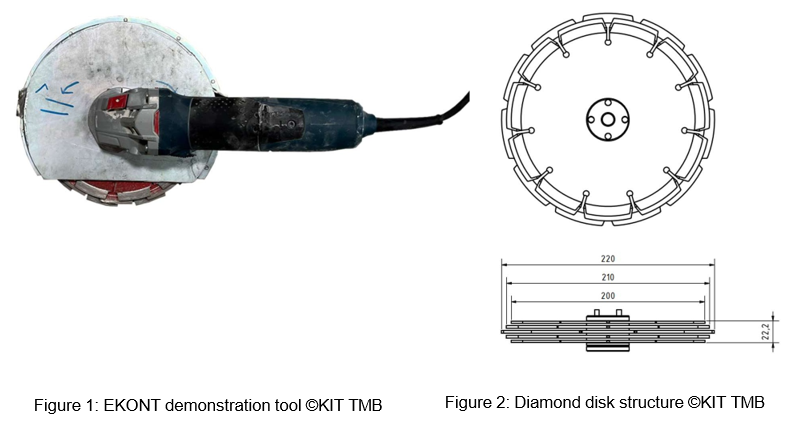
The working principle of the EKONT-tool (see Figure 1) is based on diamond discs of different diameters, which are arranged next to each other and thus form a corner angle of 90° (see Figure 2). This design allows effective penetration into the edges and removal of contaminated material. The tool can be equipped with five diamond discs, which are placed axially symmetrically on the rotating part of the grinder. The middle disc is the largest with a diameter of 220 mm, the disc diameters decrease towards the outside to 210 mm and finally 200 mm. The diamond discs on this demonstrator tool are driven by a grinder; spacers are fitted between the diamond discs to allow the individual discs to work freely while
still preventing the formation of residual concrete. The various tool mechanisms support the personnel during decontamination work with a feed speed of up to 120 cm per minute at a working depth of 10 mm, for example, and a tool weight of just 7.5 kg.
In this way, the tool produces an even surface, which is particularly advantageous for subsequent clearance measurement. The slotted diamond discs ensure optimum removal and ejection of the removed material and produce good results on the surface to be machined thanks to the diamond disk arrangement on and around the outer circumference. In many areas, the decontamination is only a few millimeters deep, so the main area of removal is in the range up to 15 mm. The housing encloses the diamond disks and is mounted directly on the carrier unit. A direct connection option for an extraction system is integrated into the housing, allowing the user to operate the tool with both hands and focus on the material removal. An additional handle can then be attached to the housing at various points, making it easier to work on internal edges between the wall and floor, wall and wall or wall and ceiling.
TEST PROGRAMM
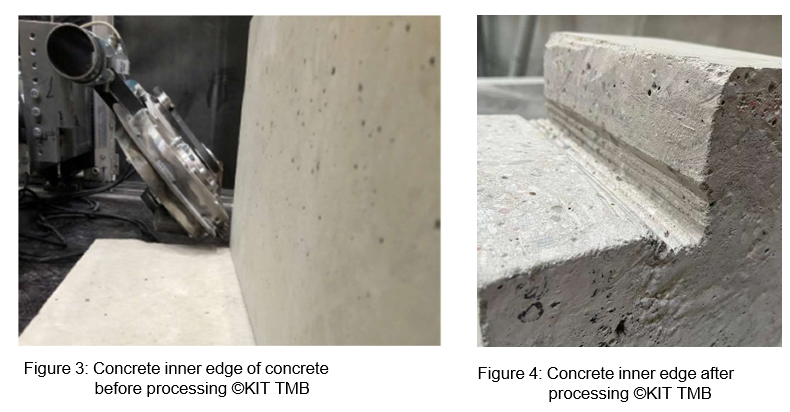
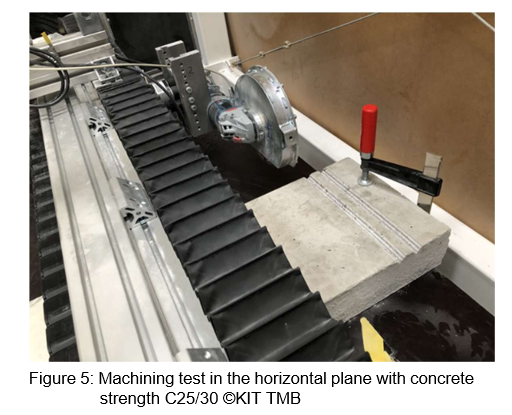
Several requirement parameters were used for tool development. In addition to performance, the tool was examined in terms of the force required by the user, the resulting surface quality with regard to the subsequent clearance measurement, dust generation during material processing and the vibrations and noise levels generated during use. The tool application was tested on different concrete strengths, such as C25/30 or C30/37, in order to demonstrate the differences in performance. A test stand was specially developed for the investigation of the parameters, which has built-in measuring sensors and in which various concrete test specimens can be examined.
RESULTS
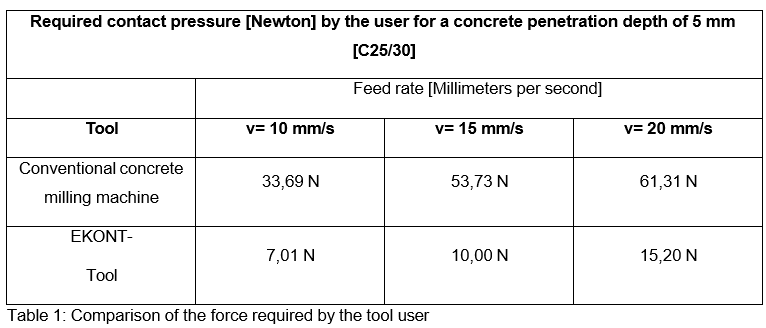
The investigations of the test series clearly show, for example, that the required contact pressure is lower with the newly developed EKONT tool (see Table 1). In practice on site, this means that users can remove material much more easily and have to apply less force to hold the tool in the desired position. Due to the lower force required, the EKONT tool can therefore be operated more precisely, as users have to use less energy to hold the tool in place and can focus on precise removal.
SITE TESTS AT NPP OBRIGHEIM
In order to test the developed EKONT tools in practice after the scientific trials in the test stand, tests were carried out on site at the nuclear power plant Obrigheim. The complex approval process and the tests themselves were carried out by the project partner SAT Kerntechnik GmbH and its employees. The main focus of these tests was to obtain reports on the experiences of the workers carrying out the tests. In addition, unexpected problems and difficulties were to be uncovered that were not taken into account in the design of the test samples and did not occur in the laboratory tests. The test tools were evaluated in the areas of ergonomics, performance and surface quality after the trials. In general, the tools were able to fulfill their purpose and there were no technical failures. What needs to be given more focus in future development is the ergonomics of the tools. Weight in particular plays an important role when it comes to how user-friendly the tool is. For this reason, further work will be carried out on this topic in particular and the remaining experience will continue to be used.
The tool function with the ability to switch between horizontal and vertical working, i.e. whether the tool is used in an inner edge between two walls or an inner edge of a wall and ceiling, has proven its worth. The enclosure protects the user from the diamond disks well as from dust. The extraction system could be easily connected to the tool and was not a geometric obstacle during the work, despite the cramped conditions. Both the decontamination coating and the underlying concrete could be removed precisely and efficiently and a time saving was clearly evident.
OUTLOOK EKONT-2
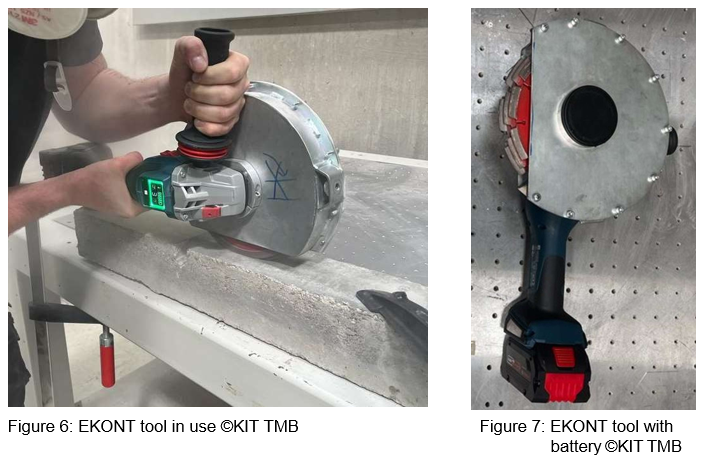
The further development of the demonstrator tools will include a battery-powered drive for the tools. In addition to further planned performance improvements to reduce the time required for decontamination, the focus will be on reducing the weight of the tools in order to further improve ergonomics. To this point, the original sheet metal housing will be replaced by a CNC-milled aluminum housing. An adjustable depth guide will enable more precise removal in order to reduce the amount of waste generated during decontamination work to a necessary minimum. On a small scale, this helps to conserve interim and final storage capacities and prevents follow-up costs.
The surface quality after machining is further improved to ensure the best possible subsequent clearance measurement. The removal of various decontamination coatings is tested and the tool is adapted accordingly and provided with an exact depth guide. Occupational safety aspects from the conventional dismantling sector are also taken into account during further development. These include the lowest possible dust generation of the tool, especially a low proportion of fine dust and the lowest possible vibration forces for the end users of the tool. The removal rate and surface quality of the tools developed in EKONT-1 already exceed those currently available on the market and will be further improved in EKONT-2.
The research focus of the EKONT-2 project is on the following topics:
- Improved handling
- Weight reduction
- Reduction of external dimensions
- Revision of the edge guide
- Improving the quality of removal
- Depth guidance and adjustable removal depth
- Creation of a surface suitable for clearance measurement
- Reduction of unnecessary material removal
- Removal of surfaces with decontamination coatings
Objectives that were focused on in the first research project are still being pursued and improved:
- Improving occupational safety
- Reduction of dust exposure
- Reduction of vibrations and strain on the musculoskeletal system
- Less time required for decontamination
0 Comments