Kaisa Pellinen
Fortum Power and Heat, Nuclear Services Keilalahdentie 2-4, 02150 Espoo kaisa.pellinen@fortum.com
SUMMARY
In this paper, we present an approach to create and develop operating manual and instructions for a new nuclear waste management facility. The aim for the instructions is to be informative, easy to follow and fulfill the needs for a new nuclear facility – not forgetting the nuclear safety.
We describe a step-by-step process for creating structured manuals that incorporates these principles, and we provide examples of how this process has been used to create effective manuals in a variety of domains.
KEYWORDS
- Operation manual
- Instruction
- Flowchart
- Verification
- Validation
INTRODUCTION
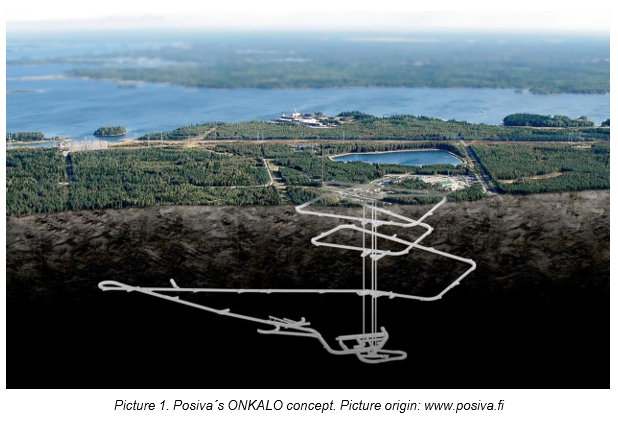
Fortum is an owner and operator of the Loviisa NPP in Finland. We (as a company) have built a low and intermediate waste repository to Loviisa site, and have been operating it almost 30 years. During that time we have gained a lot of operating experience and learnings that we have taken into account and reflected in operating practices and manuals and instructions of running a nuclear waste facility. We are also a co-owner of the nuclear waste disposal company Posiva, who is going to be first in the world to begin disposal of spent nuclear fuel into ONKALO®1 – final disposal facilities excavated deep into the bedrock.
Besides being an owner and operator of nuclear facilities, Fortum offers wide range of nuclear engineering services in designing, licensing and operating nuclear facilities and supplying related services and technologies to external clients. Our expertise covers the whole life-cycle of nuclear power plants from new builds to decommissioning and final disposal of nuclear waste. As a co-owner of Posiva, we have been supporting them in multiple aspects of designing and engineering the final disposal facilities. As the operation phase of the facilities gets closer, the need for manuals and instructions arises. Fortum has had a crucial role in creating manuals in three areas: operation, maintenance and operational limits and conditions. These manuals have been prepared under separate Operation manual project.
The aim for the Operation manual project was, that the content of the instructions will ensure that the functions of the disposal facilities comply with the regulation, the operation of the facility will be safe and that maintenance of the facilities will be proactive and carefully planned. None of the activities may endanger the nuclear safety.
METHODS
The Operation manual project consists of more than 200 separate instructions. The procedures to be instructed vary from system-specific normal operation and alarm instructions. The administrative instructions are a part of the manual, but are outlined from the scope of this project. The project was divided into three phases, that are described here in more detail.
Phase 1: Project planning and scheduling
The first phase was to define the work process and the content of the manual and to create some pilot instructions to test the process. Since the amount of instructions was significant, and there were other manuals yet to be prepared following the Operation manual project, the process needed to be smooth. The results of the pilot were sufficient, and they were used as a baseline to make a more realistic schedule and workload estimate for the remaining instructions in the Operation Manual.
The Phase 1 work began with mapping the current state of the project and updating the project plan. This involved updating the project’s goals, outputs, and metrics, as well as the project’s phasing and implementation schedule to reflect the current situation. In addition, a new resource plan was created for the project, where workload estimates were updated and responsible persons were named for the development of each instruction.
As a part of the Phase 1, content of the guidelines was defined. Since the area to be covered is significant, the defining the content of instructions and their interfaces was essential. The instruction format, structure and appearance were also decided in close cooperation with Posiva and based on the experience of Loviisa operations.
The start-up phase also defined the procedures for commenting, reviewing and approving the instructions and drafted the basic idea for the Phase 3 – verification and validation. In addition, support material was created for the authors of the instructions to facilitate the writing process as smoothly as possible
Phase 2: Writing of the manuals
The second phase was about creating and writing the instructions. The process system specific operation and alarm instructions are in text format and the procedures used in normal encapsulation and disposal process are in flowchart format.
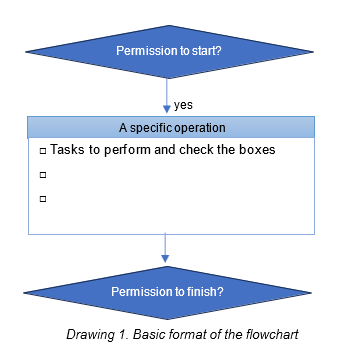
The base format for the flowchart has been in use in the Finnish nuclear power plants, including Loviisa 1 and 2 and Olkiluoto 3, but it has been adapted for Posiva´s needs. The processes involve several simultaneous dependent operation by different operators, the flowcharts were considered to be the best solution to ensure safe and successful operation. Such operators may include i.e. control room operator, field worker, security, radiation safety etc.
Operations are performed by following the flowchart. Yes → down, no → to the side. For for the case that there appears a failure in the encapsulation process, „recovery instructions“ have also had to be considered. format differing from flowcharts to written instructions. The basic format of the flowchart is shown in the drawing 1.
The flowcharts are in available in paper format and are meant to be used in the control room, but also taken in to “the field”. Text format procedures are support material that are designed to be kept in the control room.
The content of the text format instruction follows the main structure:
- System description describes an overview of the system, its safety class, performance and interfaces to the facility, especially if the interfaces are safety classified.
- Normal state is described in text, but also as a table, so it can be utilized for returning the system to the normal state. The table gives normal state position of the components and switches (open/closed, on/off etc.)
- Actions describes the operations that the operator performs during the normal operating, for example “turn on the pump, check that the pressure is in the limits, turn off the pump”
- Incidents and special situations describe how the system performs and how it is operated in possible special situations – what immediate actions are needed and how the safety functions are secured.
- Alarms describe all the alarms system receives from the automation
Phase 3: Verification and validation
The third phase is verification and validation (V&V). The goal of V&V is to ensure that instruction meets the requirements set for it and is suitable for its intended use. The verification is done in two steps. The first part is done by proof-reading the instruction. The proof-reading is done by another expert without previous contact to that specific instruction. They will check that the instruction is informative, easy to understand and corresponds to the known requirements.
After proof-reading, the instruction is taken into the site and is verified in its real environment. If the instruction requires the operator to press “the red button in the left side of the control panel”, it is checked that there is a red button to be pressed on the left side of the control panel. There is a verification form to be filled according the observations. The questions in the form refer to both proof-reading and the instruction´s compatibility to the site.
Another part of the verification is a risk assessment. It is done on-site together with the other verification activities. The instructed process is assessed on-site against several risk factors: are there a possibility of radiation, contamination, fire, chemicals, injuries by tools or other harm of injuries when operating the system according the instruction.
If there are any observations on the verifications that will lead to correcting the instructions, the corrections will be done before the validation.
Validation of the instruction is performed by running the process according the instructions. The person doing the validation is observing the process and the usability of the instruction. There is a validation form to be filled according the observations. The questions in the form refer to understating the instruction, usability of the tools, possible complications and errors. After the validation the findings are processed and a new validation is conducted if seen necessary.
All the V&V observations are recorded to forms and saved to a database.
CONCLUSION
Creating manuals and instructions for a new nuclear facility takes time and effort. There are hundreds of unique instructions, and there shall be a comprehensive approach for writing them. It is important to acknowledge and take user experiences and learnings from operating waste disposal facilities into account in development of the facility’s operating practices and instructions. Our approach worked well, since there were seasoned experts in the project management, and the piloting phase was carefully planned.
The most remarkable area for improvement would be the communication and information sharing between different interfaces.
REFERENCES
The instruction and operation manuals referred in this paper are confidential documents of operating Nuclear Power Plants, so the references are made in general level and without the exact names of the documents.
0 Comments