Maurice Klink
Hochschule Mannheim, Mannheim University of Applied Sciences Paul-Wittsack-Straße 10, 68163 Mannheim
E-mail: n.heiss@hs-mannheim.de
Niklas Heiß, Lotte Lens, Ulrich W. Scherer
Hochschule Mannheim, Mannheim University of Applied Sciences Paul-Wittsack-Straße 10, 68163 Mannheim
E-mail: n.heiss@hs-mannheim.de; l.lens@hs-mannheim.de; u.scherer@hs-mannheim.de
SUMMARY
German research reactors undergo shutdown and dismantling. The special focus is on the irradiated reactor graphite because it is problematic for the final repository, KONRAD. Through neutron activation processes, long-lived and potentially volatile radionuclides such as H-3 and C-14 are produced. Due to limited information on the production and trace elements inside the graphite, estimations of radionuclide inventories and their activities are crucial for subsequent characterization and decontamination processes. This paper covers the FLUKA simulation of radionuclide inventories for various graphite compositions, aligning with those of the TRIGA reactor in Mainz, Germany. Our results are in good agreement with simulations based on ORIGEN, showing that FLUKA is suitable for estimating the radionuclide inventories.
KEYWORDS
German research reactors, simulations, i-graphite, radionuclide inventory, characterization
INTRODUCTION
As Germany progresses with the shutdown and dismantling of its research reactors, an estimated 2000 tons of irradiated reactor graphite are being generated [1]. However, due to strict regulations governing the activities of radionuclides in the final repository KONRAD, and the necessity to minimize waste vol- ume, it is not feasible to dispose of the entire graphite without treatment [2]. During operation, a wide range of radionuclides can be generated depending on the composition of the graphite. A significant challenge arises from the lack of information regarding the elemental compositions and impurities of the reactor graphite utilized as a moderator, reflector, and structural material in the reactors [1]. In addition, the position of the graphite in relation to the reactor core and its corresponding neutron field, along with its irradiation history are relevant.
Extensive characterization is necessary to preselect materials for direct release, those needing further treatment, or final disposal. An overview of the overall issue and potential measures are discussed in the publication by L. Lens in this volume [3].
Before the experimental characterizations are being conducted it is beneficial to gain information on the radionuclide inventory and the radionuclides possibly produced. With the help of Monte Carlo based codes as TRITON/ORIGEN [4] and FLUKA [5-7] first estimations can be calculated.
The aim of this research is to assess the validity of FLUKA to describe the radionuclide inventories of graphite from various research reactors [3] by comparison with results obtained by using TRITON/ORIGEN. In close collaboration with the staff of the TRIGA reactor at the Johannes Gutenberg university Mainz first samples have been provided to undergo analysis in our laboratories. In subsequent work we will investigate graphite samples from other German research reactors to test the prediction against experimental results.
We pursue a dual approach: simulations of the radionuclide inventories as described in this contribution are complemented by measurements, as detailed in the contribution by L. Meunier in this volume [8].
METHODS
Simulations are essential to get first estimates of the radionuclide inventory and their activities. On the one hand side it provides us with an estimate for our planned work with beta-emitters, on the other hand side the presence of gamma-emitters limits handling because of the dose rates produced. While the use of the ORIGEN point-depletion code [4] is well-established for predicting activities in irradiated materials we are exploring here the predictive power of FLUKA used in our group for a manifold of radiation and particle transport problems.
FLUKA [5-7] is a Monte Carlo-based code designed for simulating particle transport and interactions with matter [9]. This versatile program can simulate the distribution and interaction of various particles, including neutrons, among its repertoire of 60 different particle types. One application of FLUKA is the calculation of activation. The statistical uncertainty of FLUKA is computed separately for each nuclide
[9] and is contingent on the number of calculation cycles and the number of primaries used. In our simulations, we used 5 calculation cycles, each with one million primaries, thereby achieving a high level of accuracy in the simulation results.
The input data required for the calculations was provided to us by the TRIGA Mainz team. In addition, we received the results of their calculations using the ORIGEN code with the same input data, enabling a comparative analysis of our findings. Figure 1 shows the neutron flux of TRIGA Mainz from a SCALE/KENO-VI-simulation.
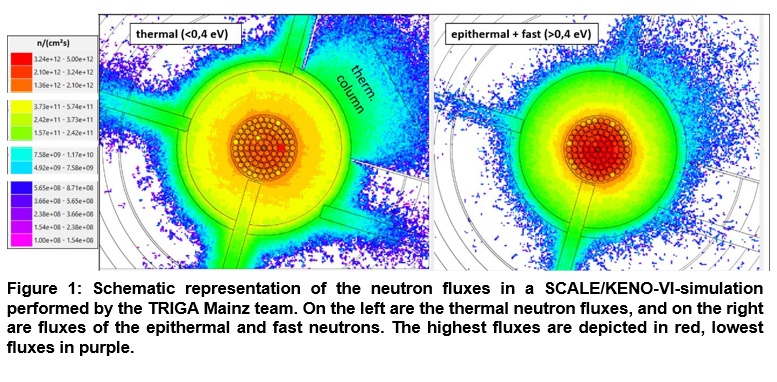
The variation of neutron fluxes within the reactor can be perceived. Neutrons propagate in all directions from the reactor core where the neutron fluxes are highest (shown in red and orange colors). The thermal column, for which the simulations are conducted, is indicated in the top right of the two sub-images. One observes a large area of high fluxes of thermal neutrons. FLUKA input was generated from this representation and the provided neutron spectrum.
To date, the trace element composition of the graphite utilized in TRIGA Mainz is unknown. Therefore, published elemental compositions of the TRIGA reactor in Finland (FiR1) [10-12] and the reflector of the AVR reactor in Forschungszentrum Jülich [13], Germany, are used as first estimates.
Table 1 lists the elements with highest mass fractions
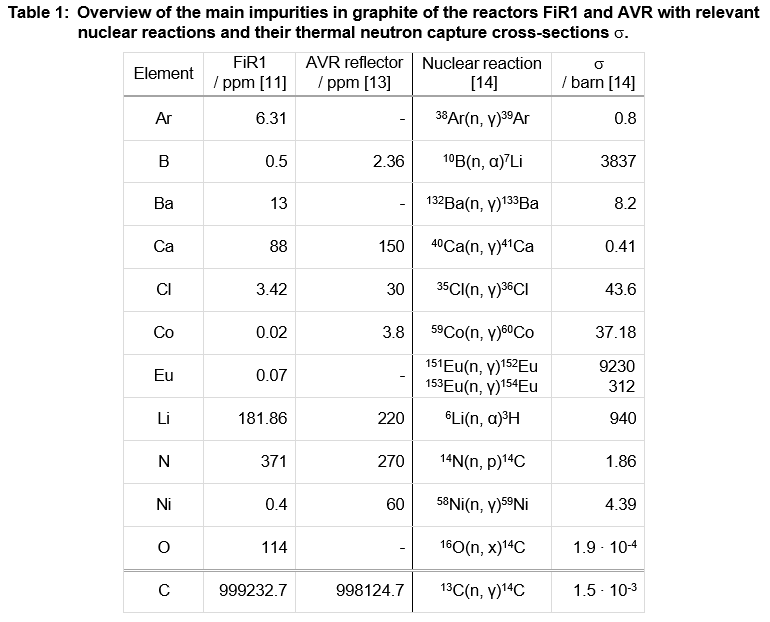
The composition in key elements of the two materials is not too dissimilar. The most relevant radionu- clides for final storage are the long-lived and potentially volatile beta-emitters, C-14, H-3, and Cl-36. As their production can occur through different nuclear reactions we anticipate different activities of these nuclides. Our simulations were conducted using both material compositions with the irradiation history, geometry, and neutron flux of TRIGA Mainz. The TRIGA reactors in Finland [10-12] and Mainz share an almost identical geometry and a comparable irradiation history, leading to analogous key radionuclide inventories in the simulations. In the subsequent paragraph we compare our simulated results with those by Räty [12] for FiR1.
RESULTS WITH DISCUSSION
Räty [12] calculated by using ORIGEN the following composition of key radionuclides as fractions of the total activity of 0.461 TBq. Main activities are: H-3, C-14, Eu-152, Co-60, Ba-133, Cl-36. These nuclides are referred to as key nuclides also due to their long half-lives, see Table 2. They can cause special problems if they can be volatilized in a final repository (see contribution by L. Lens [3]).
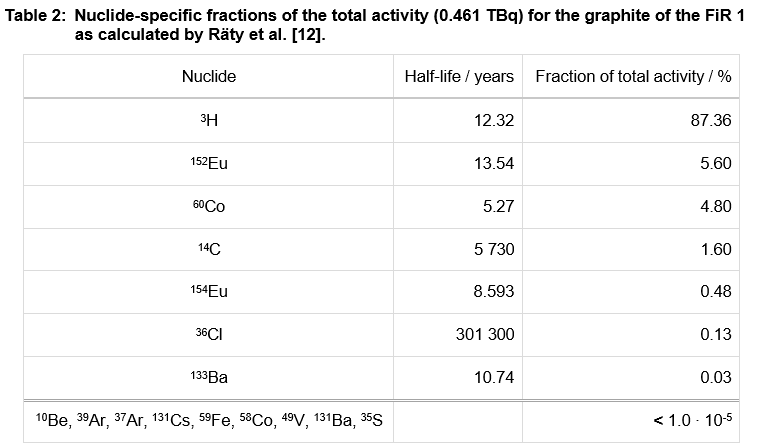
From Table 2, it is evident that high activities for individual nuclides were achieved due to the impurities present. The levels of Co-60, Cl-36, and Eu-152 likely originate from the fractions of the stable isotopes of these elements.
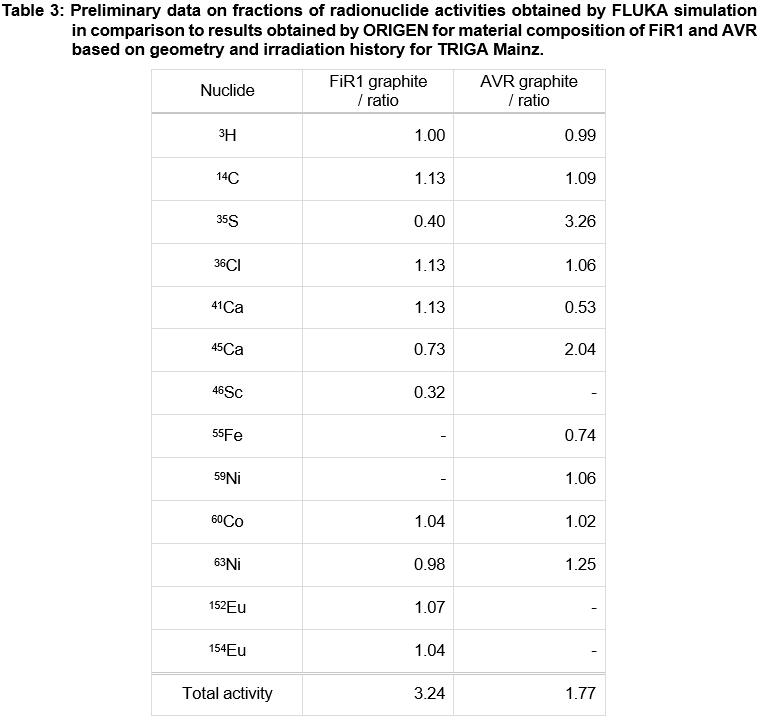
The key radionuclides in the graphite of AVR Jülich [13] were analyzed and found to be largely identical to those found in the FiR1 TRIGA. These radionuclide compositions can be compared to our simulation results by using FLUKA. The deviations between the ORIGEN simulations for the TRIGA Mainz and our results are shown in Table 3.
Results for some radionuclides can only be provided for either one of the two reactors due to different material compositions, see Table 1.
Most of the radionuclide fractions of the total activity show ratios close to 1 (see Table 3) proving very good agreement between FLUKA and ORIGEN results. However, there are larger deviations in the calculated total activities. FLUKA gives higher estimates by a factor of 2 to 3 than ORIGEN. Different cross-section databases used by the programs [7, 9] are likely to play a role here. Nevertheless, for the purpose of the present study i.e. giving a first estimate of the radionuclide inventory of irradiated reactor graphite to indicate proper handling and radiation protection measures this factor of 2 to 3 is of little relevance. Our results show that FLUKA allows to estimate radionuclide inventories properly.
CONCLUSION
Our simulation results by using FLUKA demonstrate that they correspond well with results obtained by ORIGEN simulation using the same input data (material composition, irradiation history, and neutron fluxes). Therefore, FLUKA can be considered to be a valuable tool for the simulation of nuclide invento- ries of neutron irradiated materials. In the near future, the activities of the relevant radionuclides will be determined by measurements in our radiochemistry laboratories. By comparing the measured data with the simulation results we will be able to compare the quality of the simulation results obtained by the TRITON/ORIGEN and FLUKA. In addition, the input data for the simulations can be optimized to further improve the accuracy.
REFERENCES
- INTERNATIONAL ATOMIC ENERGY AGENCY, “Progress in Radioactive Graphite Waste Man- agement, IAEA-TECDOC-1647”, IAEA, Vienna (2010)
- Bundesamt für Strahlenschutz, „Anforderungen an endzulagernde radioaktive Abfälle (Endlager- bedingungen, Stand: Dezember 2014) – Endlager Konrad“, „https://bge.de/fileadmin/u- ser_upload/Konrad/Wesentliche_Unterlagen/Endlagerungsbedingungen_Konrad/Endlagerungs- bedingungen_Konrad_Stand_12_2014.pdf“ [23.02.2024]
- Lens et al., „Characterization and decontamination of irradiated reactor graphites”, Proceedings Kerntechnik (2024)
- A. Wieselquist, R. A. Lefebvre, Eds., “SCALE 6.3.1 User Manual, ORNL/TM-SCALE-6.3.1”, UT-Battelle, LLC, Oak Ridge National Laboratory, Oak Ridge, TN (2023)
- Cerutti et al., “New Capabilities of the FLUKA Multi-Purpose Code”, Frontiers in Physics, Vol- ume 9 (2022)
- Battistoni et al., “Overview of the FLUKA code”, Annals of Nuclear Energy, Volume 82 (2015)
- Vlachoudis, “FLAIR: A Powerful But User Friendly Graphical Interface For FLUKA”, Proc. Int. Conf. On Mathematics, Computational Methods & Reactor Physics (M&C 2009), Saratoga Springs, New York (2009)
- Meunier, „Characterization of irradiated graphite samples using destructive and non-destructive methods”, Proceedings Kerntechnik (2024)
- Ferrari, A.; Sala, P.R.; Fasso, A.; Ranft, J. FLUKA: A Multi-Particle Transport Code (Program version 2021), Milan (2021)
- Räty, P. Kotiluoto, FiR 1 TRIGA Activity Inventories for Decommissioning Planning, Nuclear Technology, Volume 194:1, pp. 28-38 (2016)
- Räty et al., “Characterization measurements of fluental and graphite in FiR1 TRIGA research reactor decommissioning waste”, Nuclear Engineering and Design, Volume 353, 110198, (2019)
- Räty „Activity characterization studies in FiR1 TRIGA research reactor decommissioning pro- ject“, Doctoral school in natural sciences dissertation series – University of Helsinki (2020)
- Kuhne et al., “Entsorgung von bestrahltem Graphit (CarboDISP): Abschlussbericht”, Institut für Energie – und Klimaforschung (IKE-6), Forschungszentrum Jülich GmbH (2015)
- Zerkin, ENDF: Evaluated Nuclear Data File: Database Version of 25.08.2023 (2023) https://www-nds.iaea.org/exfor/endf.htm [23.02.2024]
ACKNOWLEDGEMENTS
This project is supported by the federal ministry for education and research [15S9442]. A special thanks to the staff of TRIGA Mainz for collaborating and providing samples, information and simulation data of the reactor.
0 Comments