Lotte Lens
Hochschule Mannheim, Mannheim Universtiy of Applied Sciences Paul-Wittsack-Straße 10, 68163 Mannheim
Lorie Meunier, Niklas Heiß, Ulrich W. Scherer
Hochschule Mannheim, Mannheim University of Applied Sciences Paul-Wittsack-Straße 10, 68163 Mannheim
l.meunier@hs-mannheim.de; n.heiss@hs-mannheim.de; u.scherer@hs-mannheim.de
SUMMARY
Germany’s many research reactors have contributed significantly to scientific advancement. Now that most of them are shut down, innovative strategies are essential for decommissioning and waste management. This study focuses on the characterization and decontamination of irradiated reactor graphite. Various radionuclides, including the volatile H-3 and C-14, can be produced during operation. Limited information on graphite production conditions means valid predictions of the
radionuclide inventory is difficult. Without pretreatment, KONRAD’s capacity for C-14 is expected to be filled only by materials from research reactors. Initial efforts aim to characterize the irradiated graphite quantity, homogeneity, and volatility. This will allow a preselection of materials potentially suitable for direct release or storage at KONRAD without further treatment. For materials needing treatment, innovative decontamination methods are being developed.
KEYWORDS
Decommissioning, i-graphite, final disposal, innovative decontamination, characterization
INTRODUCTION
In 2023, the remaining nuclear power plants (NPPs) in Germany were shut down. Alongside NPPs, Germany has a diverse array of research reactors operating since the late 1950s, each playing a vital role in advancing scientific knowledge and technological innovation. From standard designs such as TRIGA or SUR to specially designed facilities in Munich, Rossendorf, Geesthacht, Berlin, and Jülich, these research reactors have made a significant contribution to various fields of research. However, with some reactors already undergoing decommissioning processes and others scheduled for closure in the near future, there is an urgent need to develop innovative strategies for dismantling and managing their radioactive waste.
Both conventional nuclear power plants and research reactors present unique challenges in decommissioning and waste management. While the scale and nature of these challenges may differ, the overall objective remains the same: to minimize the radioactive waste volume and to ensure its safe handling and disposal. To achieve this goal, the development and implementation of cutting-edge technologies and methodologies tailored to the specific characteristics of each facili ty and its materials are necessary.
An area of focus is the characterization and decontamination of irradiated reactor graphite, a key component found in many research reactors in Germany and conventional reactors worldwide. Graphite is employed in a variety of roles, including fuel elements, moderators, reflectors, and structural materials. This is due to the low neutron capture cross-section and very good moderating properties of C-12 [1].
Globally, there are an estimated 250,000 tons of irradiated graphite, with approximately 2,000 tons located in Germany.
While modern contemporary reactors use highly purified graphite, the historical lack of information on production conditions and potential impurities in older reactors has led to varying qualities. Even within the same facility, the level of contaminating elements and trace elements can differ significantly. Depending on the location of the graphite relative to the reactor core and its respective neutron field, combined with the irradiation history, a large variety of radionuclides can be produced during operation.
In principle, the radionuclide content can be calculated from analytical data, and the existing irradiation history using Monte-Carlo based simulation codes such as ORIGEN or FLUKA [2-8]. However, in most cases, the associated information is missing, e.g., manufacturing protocols and the content of trace elements. Consequently, the calculated data can only provide assumptions on expected radionuclides and their activities. It is important to note that certain factors, which are not accounted for in the simulations, may influence the results. These include physicochemical processes that occur during reactor operation. These processes can lead to the redistribution and potential release of radionuclides [9]. Examples of these processes include diffusion, radiolysis, and corrosion in the presence of oxygen [10]. This leads to structural changes within the graphite during operation, which can be observed by a significant increase in porosity [11]. Furthermore, the distribution of radionuclides within the graphite can change over time, particularly depending on the storage method used after dismantling. In wet storage conditions, water permeates the pores, initiating radiochemical reactions that result in the dissolution of specific radionuclides from the matrix. It is also essential to understand that substantial portions of the radionuclide volume can be released from the graphite during operation. Therefore, a thorough experimental characterization of the irradiated graphite is essential.
A combination of simulations and experimental characterization was used in dismantling the FiR1 TRIGA Reactor in Finland. Typical radionuclides found in the irradiated graphite after operation included H-3, C-14, Cl-36, Eu-152, Co-60, Ba-133, Cs-134, Be-10, Ar-39, Ar-37, Cs-131, Fe-59, Co-58, V-49,
Ba-131, and S-35. The largest share of the total activity was attributable to H-3 (87.36%), Eu-152 (5.60%), Co-60 (4.80%), and C-14 (1.6%). The share of all other radionuclides was determined to be below 1% [12]. Similar radionuclide inventories are anticipated for research reactors of the same type in Germany [4].
The potential release behavior of radionuclides into the environment is crucial for determining their suitability for disposal. The KONRAD final repository has specific guidelines allowing maximum activities of radionuclides for disposal, particularly focusing on those with high volatility, diffusion propensity, long half-lives, and strong interaction with the human body. Of particular significance are the radionuclides H-3 and C-14, for which the maximum activities have been defined as 6.0.1017 Bq (H-3) and 4.0.1014 Bq (C-14) [13]. In addition to the very long half-life of C-14 with 5730(30) years [14], the volatility and propensity for diffusion of both radionuclides play a significant role.
Studies have shown, that the volatility of C-14 depends on its formation pathway [15,16]. The three main formation pathways are shown in Table 1.
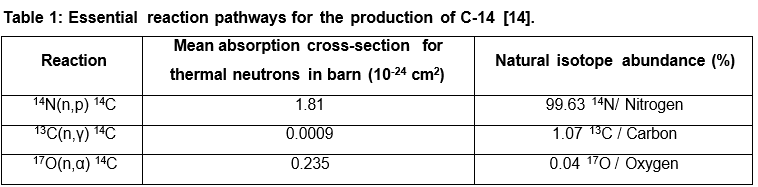
The primary source of C-14 is the 14N (n, p) 14C reaction. As nitrogen is predominantly located on the surface of the material as an impurity, it is likely to diminish uniformly into the graphite’s interior [15]. Consequently, the resulting radioactive carbon remains unbound within the matrix and can thus be easily released. In contrast, carbon produced from the reaction with C-13 exhibits stronger fixation [16]. The release of surface-bound radioactive carbon can be attributed to desorption facilitated by oxygen- functionalized chemical units, particularly at lower operating temperatures during reactor operation [16].
Conversely, at higher temperatures, binding effects occur, leading to bonding of C-14 within the graphite matrix, a phenomenon known as annealing.
Chemical reactions that occur during the storage in either a dry or wet state can result in the formation of simple organic molecules that exhibit high volatility. This may add a significant contribution to the release of C-14 from irradiated graphite [16, 17].
Given the possible release of H-3 and C-14 under repository conditions, direct disposal without pretreatment is not feasible. Furthermore, it must be considered that the small volume of irradiated reactor graphite present in Germany would occupy a significant portion (approximately 80%) of the specific radionuclide inventory of the KONRAD repository, leaving limited space for materials from conventional reactors and industry.
Due to the aforementioned challenges, the primary objective of this project is to conduct a comprehensive experimental characterization of German irradiated graphite samples with regard to their radionuclide inventories, homogeneity, and volatility. This allows for the pre-selection of materials for direct release or those requiring further treatment. For materials exceeding the clearance limit, sustainable decontamination processes suitable for industrial application are investigated.
Methods
The project presented here begins with the acquisition and commissioning of all necessary equipment and the completion of a method validation. A close collaboration with staff of the TRIGA Reactor in Mainz and the JEN in Jülich was initiated, to conduct the inventory assessment. The initial challenge lies in the representative sampling of graphite elements, which exhibit heterogeneous trace element distributions and have been subjected to temporally and spatially variable neutron fields. Therefore, sampling strategies have been discussed, and initial graphite samples, both irradiated and non- irradiated, from the research group in Mainz, have been delivered and are currently undergoing comprehensive radiological characterization, including potential classification. A dual approach is being pursued.
Based on the information provided by the research group in Mainz, radionuclide inventories and activities of the thermal column of their TRIGA reactor are being calculated using the MC-based Fluka simulation program. This involves using input data such as the geometry of the reactor, neutron flux, and potential graphite compositions in the simulation. Subsequently, the simulated results are compared with experimental data obtained, and the simulations are optimized based on these comparisons. For further details on this methodology, a paper by M. Klink [4] and poster by N. Heiß is provided. The inventory of radionuclides (α-, β-, and g-emitters), their activity, as well as their spatial distribution within the graphite samples are determined by a variety of specific measurements. The spatial distribution and homogeneity are being investigated via autoradiography and microscopy. The qualitative and quantitative determination of g– emitting nuclides can be easily achieved by measuring their penetrating gamma radiation using high-purity germanium (HPGe) detectors. For the most common and radiologically significant pure beta emitters, such as H-3, C-14, or alpha emitters, non-destructive detection is not possible. Prior to their measurement with a Liquid Scintillation Counter, sample preparation using an oxidizer is mandatory.
As part of the characterization process, additional thermal experiments are conducted to determine the volatility of the relevant beta-emitters and to differentiate between volatile and bound fractions. These experiments involve subjecting the irradiated graphite samples to controlled temperature and humidity conditions to simulate the potential release of volatile radionuclides under repository conditions. If the volatile fraction of C-14 contained in the graphite is <1%, it could significantly reduce the problem of the graphite to be disposed in the KONRAD repository. Further details on the characterization process can be found in the contribution by L. Meunier [18].
The information obtained during the characterization and classification of the graphite samples is crucial in developing sustainable and effective decontamination techniques.
In previous studies, a variety of decontamination methods have been investigated, including thermal and electrochemical processes (see references 19-21). However, none of these methods have resulted in the development of a standard procedure that can be implemented today.
In this project, we want to compare two decontamination methods.
Building on the results of previous research projects [21,22], promising techniques for the thermochemical treatment of irradiated graphite will be further investigated. Thermal methods have frequently been employed in inert or reactive gas atmospheres. However, due to technical limitations, temperatures have typically been constrained to approximately 1,000°C. Experiments conducted with the addition of steam have shown promising decontamination impacts [22]. However, experimental data indicates that significantly higher release rates could be achieved at higher temperatures than those used in the aforementioned study [22]. In this project, we seek to address this issue by employing advanced, state-of-the-art equipment.
Additionally, as an innovative approach, the extraction of radionuclides using supercritical solvents wil l be investigated. Both methods will be compared and evaluated in terms of their decontamination efficiency, cost-effectiveness, radiological safety, and sustainability.
The most promising method will be assessed for scalability and suitability for use in decommissioning projects with the assistance of industry partners. This collaborative effort will ensure that the selected method meets the necessary standards and regulations for practical implementation.
Subsequently, the potential international use of the selected decontamination method will be evaluated. The definition of radioactive waste and the guidelines for final disposal in the relevant countries (eg. France or the United Kingdom) must be taken into account.
In contrast to Germany, nuclear energy is being expanded worldwide. Reactor graphite continues to be used as a reflector, moderator, or structural material. We see the possibility of decontamination methods, as a way of recycling the high-purity and valuable irradiated graphite for reuse in new power plants.
CONCLUSION
This study addresses the challenges associated with the decommissioning of Germany’s research reactors. Specifically, the objective is to develop innovative strategies for the characterization and decontamination of irradiated graphite, a key component in these reactors. Extensive studies are being conducted to identify reliable methods for characterizing and validating these strategies for implementation. Subsequently, we will perform detailed research on promising decontamination methods. Collaborative efforts with industry partners will facilitate the implementation of scalable and sustainable solutions that meet regulatory standards. This work contributes to maintaining expertise and competence in nuclear engineering in Germany.
REFERENCES
- INTERNATIONAL ATOMIC ENERGY AGENCY, “Progress in Radioactive Graphite Waste Management”, IAEA-TECDOC-1647, IAEA, Vienna (2010).
- Mehta, “Estimation of Activity Inventory in the Graphite Reflector of FRJ-2”, Masterthesis FH
Aachen Campus Jülich, (2005)
- Bourauel, “Calculation of Neutron Flux Distribution for the FRJ-2 research reactor with the Monte Carlo Simulation Code MCNP”, (August 2006)
- Klink et. al., “Estimation of radionuclide inventory and activities of irradiated reactor graphites using the Monte Carlo based program FLUKA”, Conference proceeding Kerntechnik 2024, (2024)
- Cerutti et. al., “New Capabilities of the FLUKA Multi-Purpose Code”, Frontiers in Physics, Vol.9,
(2022)
- Battistoni et. al., “Overview of the FLUKA code”, Annals of Nuclear Energy, Vol. 82, (2015)
- Vlachoudis, “FLAIR: A Powerful But User Friendly Graphical Interface For FLUKA”, Proc. Int. Conf. On Mathematics, Computational Methods & Reactor Physics (M&C 2009), Saratoga Springs, New York, (2009)
- A. Wieselquist, R. A. Lefebvre, Eds., “SCALE 6.3.1 User Manual, ORNL/TM-SCALE-6.3. 1 ”, UT-Battelle, LLC, Oak Ridge National Laboratory, Oak Ridge, TN (2023)
- George, “Analysis of Stored Energy in Graphite Reflectors”, Masterproject work FH Aachen
Campus Jülich, (2005)
- Chrostek, „Entwicklung und Validierung einer Apparatur zur Untersuchung der Graphitkorrosion“, Bachelorthesis FH Aachen Campus Jülich, (2009)
- Diekmann, „Eindringverhalten wässriger Phasen in Graphitporen“, Diplomarbeit FH Aachen,
(2007)
- Räty, “Activity Characterization Studies in FiR 1 TRIGA Research Reactor Decommissioning Project”, Dissertation, (2016)
- Niedersächsisches Umweltministerium, „Planfeststellungsbeschluss für die Errichtung und den Betrieb des Bergwerkes Konrad in Salzgitter als Anlage zur Endlagerung fester oder verfestigt er radioaktiver Abfälle mit vernachlässigbarer Wärmeentwicklung“ vom 22. Mai 2002, Az.: 41- 40326/3/10, Hannover, (Mai 2002)
- Zerkin, ENDF: Evaluated Nuclear Data File: Database Version of 25.08.2023 https://www-nds.iaea.org/exfor/endf.htm, (2023)
- “Alternative Option of Managing Irradiated Graphite”; Proceedings of the Waste Management Symposium 2010, Bd. CD, Proceedings of WM2010 Waste Management Symposium Phoenix, Phoenix & GRAPA II, (2010)
- Labrier, ML. Dunzik-Gougar, “Characterization of C-14 in neutron irradiated NBG-25 nuclear graphite”, J. Nucl. Mat., 448, pp.113-120, (2014)
- Kuhne et al., “Entsorgung von bestrahltem Graphit (CarboDISP), Abschlussbericht“, Institut für Energie- und Klimaforschung (IKE-6), Forschungszentrum Jülich GmbH, Abschlussbericht BMBF 02S8790, (2015)
- Meunier et. al., “Characterization of irradiated graphite samples using destructive and non- destructive methods”, Conference proceeding Kerntechnik 2024, (2024)
- BMBF FORKA Zwischenbericht 2020, GRS, (2020)
- BMBF FORKA Zwischenbericht 2021, GRS, (2021)
- “Irradiated Graphite Processing Approaches”, IAEA TECDOC Draft, (to be published 2023)
- Kraus, “Determination of decontamination factors of irradiated nuclear graphite by steam reforming”, Bachelor Thesis FH Aachen Campus Jülich, (2013)
ACKNOWLEDGEMENTS
The project is supported by the Federal Ministry for Education and Research [15S9442]. A special thank you to the staff of the TRIGA Mainz and JEN Jülich for collaborating and providing us with samples and information.
0 Comments