Pratibha Yadav
Institut für Kernenergetik und Energiesysteme – Universität Stuttgart Pfaffenwaldring 31, 70569, Stuttgart, Germany pratibha.yadav@ike.uni-stuttgart.de
Reuven Rachamin, Jörg Konheiser Helmholtz-Zentrum Dresden-Rossendorf Bautzner Landstraße 400 – 01328 Dresden r.rachamin@hzdr.de, j.konheiser@hzdr.de
SUMMARY
This paper discusses the challenges of using Monte Carlo calculations for radiation shielding analysis. Complex shielding scenarios often yield unreliable outcomes due to inadequate particle sampling. To enhance the efficiency of analog Monte Carlo simulations, the paper discusses variance reduction techniques offered by the MCNP code, specifically the weight window method for optimizing shielding calculations. However, for intricate shielding cases, especially with deep penetration, the existing MCNP’s weight window generator is less effective. To address this, an automated code named TRAWEI was developed, utilizing recursive Monte Carlo methodology to generate optimal weight parameters in a single run, thus reducing computation time. This paper verifies TRAWEI-generated weights using a simple reactor model and compares MCNP results utilizing TRAWEI-generated weights against those using MCNP’s weight window generator.
KEYWORDS
Shielding calculations, MCNP code, Variance reduction techniques, Weight window, TRAWEI code
1. INTRODUCTION
Radiation shielding is a critical aspect of nuclear engineering and plays an important role in ensuring the safety of people, the public, and the environment near nuclear facilities. Monte Carlo methods are commonly used to analyze and create efficient radiation shielding solutions. By simulating the transport of radiation particles through shielding materials, Monte Carlo calculations offer a detailed and precise means of assessing shielding effectiveness, optimizing design parameters, and minimizing probable risks. Monte Carlo N-Particle Transport (MCNP) code [1] developed by Los Alamos National Laboratory serves as the established standard code utilized for performing such calculations due to its adaptability and reliability. However, challenges arise, particularly in circumstances involving deep penetration, in which particles pass through thick shield materials to reach target areas. Because of the substantial absorption and scattering, a large number of particles do not reach far into the desired areas. This often leads to insufficient particle sampling in the desired target areas, causing significant statistical fluctuations in analog Monte Carlo results. To enhance the accuracy and efficiency of these simulations, the weight window (WW) variance reduction technique is frequently used. This method aims to improve particle sampling by controlling the population of particles entering specific region through splitting and Russian roulette techniques [2]. Typically, users use an automatic inbuilt MCNP weight window generator (MCNP-WWG) to establish weight window parameters. However, for intricate shielding scenarios such as deep penetration, the generator necessitates multiple iterations of Monte Carlo calculations to produce an optimal set of variance reduction parameters, leading to significant computational demands. In response, several researchers proposed alternative methods, such as deterministic methods [3,4,5], MAGIC method, reduce density method [6] etc., to evaluate the weight window values implicitly and explicitly. However, each of these methods has its own set of advantages and disadvantages. Hence, this study aims to address the issue of multiple iterations linked with the
standard MCNP-WWG by introducing an automated tool utilizing recursive Monte Carlo (RMC) methodology [7, 8, 9]. This tool aims to generate optimal weight values in a single iteration, thereby minimizing computational time. Incorporating this methodology into Monte Carlo codes offers a more efficient approach to handling complex shielding scenarios. This paper includes an overview of weight window techniques, the theoretical foundation of the RMC methodology, the verification of the developed algorithm using a simple reactor model, and future prospects.
2. THEORY
2.1. WEIGHT WINDOW TECHNIQUE
The weight window (WW) is a crucial method employed in Monte Carlo simulations to effectively manage variance and enhance simulation efficiency. This method involves space-energy (or time)-dependent splitting and Russian roulette techniques to regulate particle populations within designated regions [2]. To implement the WW technique, the user specifies the lower weight bound and the width of the weight window for each region or cell. If the weight of a particle exceeds the upper weight bound, it is split such that the splitting particles have a weight within the weight window. Conversely, if the weight of a particle reaches the lower weight bound, Russian roulette is played, and the weight of the particle is either increased to be within the weight window or the particle is eliminated. The determination of weight window parameters typically relies on the reciprocal of particle importance. These values can either be manually inputted or automatically generated through a weight window generator. Particle importances are characterized as the anticipated scores generated by a unit weight particle upon entering a specific region. The MCNP code incorporates a built-in weight window generator, which automatically computes the lower weight window bound. By default, the upper weight window bound is set to five times the generated lower weight window bound [10].
2.2. RECURSIVE MONTE CARLO METHODOLOGY
The concept of recursive Monte Carlo (RMC) method, initially proposed by Goldstein and Greenspan [11], has been adapted and revised to address deep penetration challenges in this study [7, 8, 9]. In the RMC methodology, the importance of individual cells or regions is determined by solving the forward transport equation and sequentially defining the cells one by one as source cells. The calculation process begins with the lowest energy particles within the designated target area and progresses to adjacent regions. If a particle reaches the boundary of a previously assessed region, the computation halts, and the known importance is utilized for the preceding evaluation. Once the importance for all regions within the same energy level is assessed, the procedure repeats for particles with higher energy levels. However, while calculating higher-energy particles, there’s a chance of scattering (elastic and inelastic), causing the particle’s energy to drop to lower levels. In such cases, the previously determined importance of lower-energy particles can be applied to subsequent assessments. Once importance is determined for all regions across all energy levels, weights are computed by taking the reciprocal of the importance. This approach offers the benefit of speeding up weight calculation by making use of previously estimated importances from nearby regions or lower-energy groups. It is an automated method that does not require any iterative processes.
The RMC method has been included in the TRAWEI code, an in-house code developed at the Helmholtz-Zentrum Dresden-Rossendorf (HZDR). TRAWEI is specifically designed to generate weights for the TRAMO code, which is used for solving particle transport problems [12, 13]. In the context of this study, the aim is to utilize the weight values produced by TRAWEI for MCNP calculations in a single step. TRAWEI has the capability to replicate MCNP meshes, thus facilitating the creation of an MCNP mesh within TRAWEI for weight calculations. Once the weights are generated, they are subsequently used in MCNP for the actual calculation process.
3. VERIFICATION OF THE METHODOLOGY
In order to assess the effectiveness of weight values produced by the TRAWEI (RMC) code, a simple 3D reactor model with 90º symmetry was prepared [9], closely resembling a PWR model (cf. Figure 1). The model consists of 13 axially aligned cylindrical bodies interleaved with different shield materials. Its dimensions include an outer radius of 330 cm and a height of 120 cm, with a uniform volumetric neutron source positioned within the radial range of 0-150 cm. Using this model, MCNP simulations with an F1
tally was used to calculate the net neutron current across the outer cylinder surface of the biological concrete shield (at 330 cm). The MCNP simulations were performed in three ways:
- Analog MCNP simulation without weight window,
- MCNP simulation (MCNP-WWs) using MCNP-generated weight parameters,
- MCNP simulation (TRAWEI-WWs) using weight parameters generated by the TRAWEI (RMC)
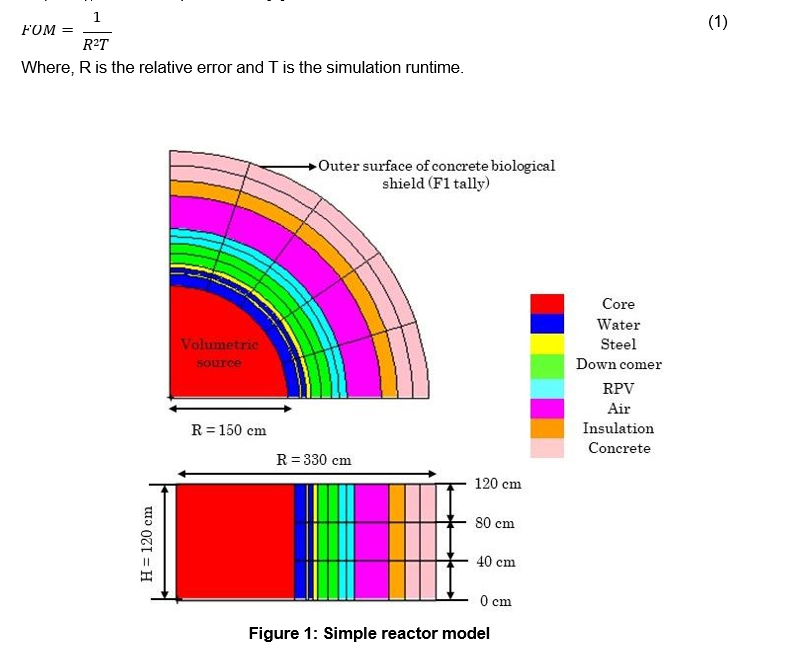
To perform the MCNP simulation with weight window, a set of weight parameters for two energy groups (thermal and high) was generated using MCNP-WWG and the TRAWEI code, respectively, specifically optimized for the outer surface of the biological shield. Furthermore, the analysis of the MCNP (TRAWEI- WWs) simulation involved a comparison of its computational efficiency with that of analog MCNP and MCNP (MCNP-WWs) simulations. Typically, computational efficiency is assessed using a Figure of Merit (FOM), which is expressed as [1]:
3.1. COMPARATIVE ANALYSIS OF WEIGHT DISTRIBUTION AND FINDINGS
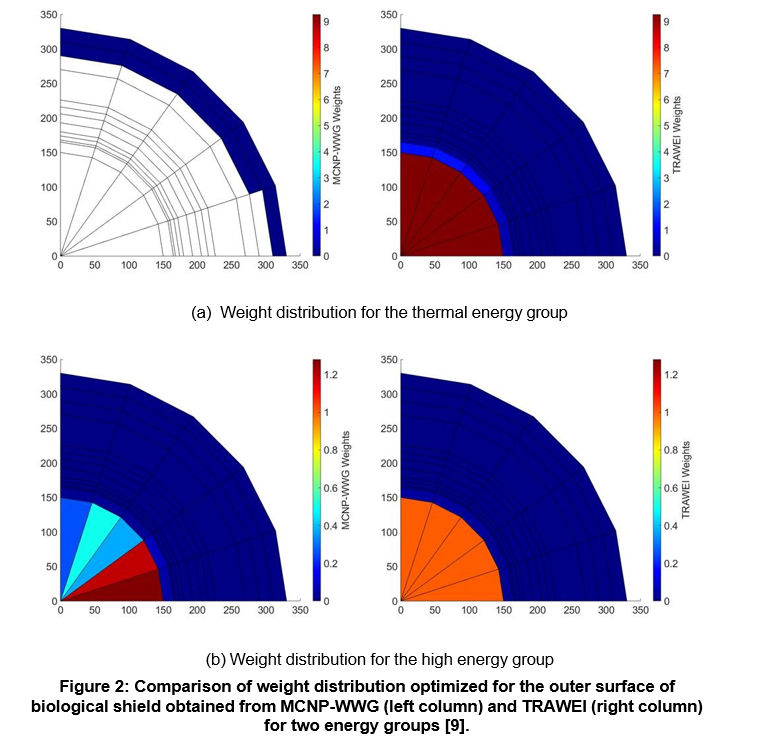
Figures 2(a) and (b) depict a comparison between the weight distributions optimized for the outer surface of the biological shield using both MCNP-WWG and TRAWEI across two energy groups spanning the entire middle layer (40-80 cm) of the model. In the thermal energy group ranging from 0 to 3.06 eV, MCNP-WWG generates inadequate weight values, with numerous regions showing zero weight, as indicated in white in Figure 2(a). Conversely, TRAWEI demonstrates better performance in this range, with each volume element possessing weight values. In the higher energy group ranging from 3.06 eV to 20 MeV, both methods yield comparable weight distributions across the majority of the body. The similarity in distributions between these two methods in the higher energy group, but not in the thermal group, can be attributed to the different mean paths of neutrons at different energy levels. In the thermal group, many nuclides possess significantly larger cross-sections, causing neutrons to travel shorter
distances before interacting. As a result, neutrons in this range are more prone to interactions than those in the high energy group. As energy levels increase, neutrons can penetrate deeper, demonstrating the capability of MCNP-WWG to achieve a weight value distribution akin to that of TRAWEI. It is important to highlight that MCNP-WWG encountered challenges in generating non-zero weight values for various regions, primarily due to its reliance on sufficient particle sampling for accurate weight window parameters. The generator is limited to optimizing one tally at a time and cannot optimize multiple tallies [14]. Nonetheless, the implementation of TRAWEI effectively achieves the primary objective, ensuring that the generated weights adequately encompass the majority of distant regions from the source across different energy levels.
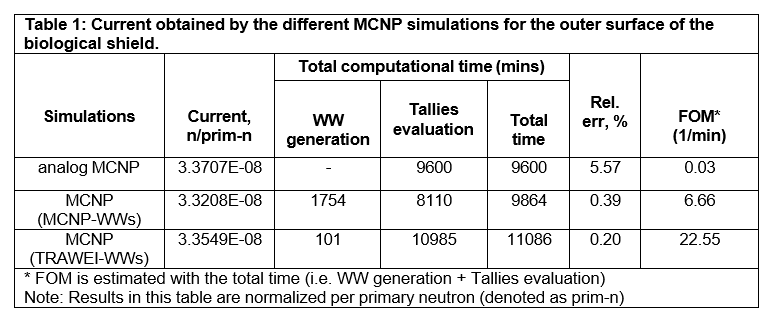
Moving forward, the next step involved utilizing the generated weights from MCNP-WWG and TRAWEI to optimize analog MCNP simulations and compare their results. To achieve a similar calculation time, the MCNP simulation using TRAWEI-generated weight values (TRAWEI-WWs) was conducted with 7.0 x 10⁸ neutron particles, while the analog MCNP simulation and the MCNP-WWs simulation were performed with approx. 6.0 x 10⁹ and 1.0 x 10⁹ neutron particles, respectively. The obtained results from these different MCNP simulations, as presented in Table 1, focus on the net current of neutrons crossing the outer surface [9]. Upon analyzing the calculation results, it was observed that the current values estimated by all three simulations were approximately same over wide range of orders of magnitude. Specifically, the MCNP-WWs results reduced the relative error by over one order of magnitude and increased the FOM by approximately 222 times compared to the analog MCNP results (cf. Table 1). Meanwhile, the MCNP results obtained using TRAWEI-generated weights (TRAWEI-WWs) demonstrated a significant reduction in the relative error by factors of 28 and 2, respectively, compared to the analog MCNP and MCNP-WWs simulations. Moreover, the FOM of the TRAWEI-WWs simulation showed significant enhancements by approximately 750 and 4 times, respectively, compared to the other two simulations (analog MCNP and MCNP-WWs) (cf. Table 1).
4. CONCLUSION
Weight window is one of the powerful variance reduction techniques that are widely used for optimizing Monte Carlo calculations. This technique adjusts the particle population and improves sampling in specific regions of interest by splitting or killing particles (via Russian roulette) within an interval defined by lower and upper weight bounds. These weight window parameters can be specified manually or generated by standard tools like MCNP’s weight window generator (MCNP-WWG). However, in intricate systems, its application encounters a significant issue: it often produces inaccurate weight window parameters with standard MCNP-WWG, usually requiring multiple iterations. To address these issues, an automated TRAWEI code based on the recursive Monte Carlo (RMC) method has been developed. The code streamlines the estimation of optimal weight parameters in a single run, significantly reducing calculation time. The performance of the TRAWEI code has been verified across various test cases, including simplified reactor models [8, 9], demonstrating superior performance compared to conventional weight-generation tool. This novel development holds potential for enhancing deep penetration shielding calculations and facilitating future decommissioning studies.
The versatility of the weight window application across different test cases shows its potential for various reactor safety and shielding applications. The future plan involves integrating this variance reduction tool with MCNP simulations for a detailed analysis of radiation distribution around SMR reactors, especially near the pressure vessel, under different operating conditions. A key focus of upcoming
research will be the examination of how damage to the reactor’s vessel wall influences radiation spread, which is crucial for safety and performance. The results of these studies could lead to using the reactor’s radiation for imaging tests of components, improving safety and structural checks. This research direction aims to greatly enhance the reliability and safety of nuclear reactors, underlining the vital role of advanced simulation tools in nuclear engineering.
REFERENCES
- B. Pelowitz, A. J. Fallgren, G. E. Mcmath, “MCNP6 User’s Manual, Code version 6.1.1beta”, Los Alamos, 14-00745 (2014).
- E. Booth, “Sample problem for variance reduction in MCNP”, No. LA-10363-MS. Los Alamos National Laboratory (1985).
- W. Mosher, S. R. Johnson, A. M. Bevill, A. M. Ibrahim, C. R. Daily, T. M. Evans, J. C. Wagner,
- O. Johnson, R. E. Grove, “ADVANTG – an automated variance reduction parameter generator”, ORNL/TM-2013/416 Rev, 1 (2013).
- Sweezy, F. Brown, T. Booth, J. Chiaramonte, B. Preeg, “Automated variance reduction for MCNP using deterministic methods”, Radiation protection dosimetry, 116(1-4), 508-512 (2005).
- Haghighat, J. C. Wagner, “Monte Carlo variance reduction with deterministic importance functions”, Progress in Nuclear Energy, 42(1), 25-53 (2003).
- Pan, K. Wang, “An adaptive variance reduction algorithm based on RMC code for solving deep penetration problems”, Ann. Nucl. Energy, 128, 171–180 (2019).
- Yadav, R. Rachamin, J. Konheiser, “Weight values for MCNP calculation based on Recursive Monte-Carlo method”, International Conference on Radiation Shielding and 21st Topical Meeting of the Radiation Protection and Shielding Division 521–524 (2022).
- Yadav, R. Rachamin, J. Konheiser, S. Baier, “Generation of optimal weight values based on the recursive Monte Carlo method for use in Monte Carlo deep penetration calculations”. Nucl. Sci. Eng.,198.2, pp. 497-507 (2024).
- Yadav, R. Rachamin, J. Konheiser, S. Baier, “Estimation of weight window parameters based on recursive Monte Carlo approach for reactor shielding problems”, Annals of Nuclear Energy, 197, p.110277 (2024).
- E., Booth, “Common misconceptions in Monte Carlo particle transport”, Applied Radiation and Isotopes, 70(7), 1042-1051 (2012).
- Goldstein, E. Greenspan, “Recursive Monte Carlo Method for Estimating Importance Function Distributions in Deep Penetration Problems”, Nucl. Sci. Eng., 76, 308-322 (1980).
- U. Barz, J. Konheiser,“ Monte-Carlo Programm TRAMO – Möglichkeiten und Anleitung zur Nutzung“, Report FZR-245, Forschungszentrum Rossendorf (1998).
- Konheiser, S. Mittag, H. Viehrig, B. Gleisberg, “Application of different nuclides in retrospective dosimetry”, Journal of ASTM International, 9 (2012).
- Munk, and R.N. Slaybaugh, “Review of hybrid methods for deep-penetration neutron transport”,
Nuclear Science and Engineering (2019).
ACKNOWLEDGEMENTS
The research outlined in this paper received funding from the Federal Ministry of Education and Research (BMBF) under contract number 15S9409A. Additionally, ongoing work is supported by BMBF under contract number 02NUK085. The authors bear responsibility for the scientific integrity of the content.
0 Comments