Lars Heibges
RPTU University of Kaiserslautern-Landau Institute of Structural Analysis and Dynamics
Paul-Ehrlich-Straße 14, 67663 Kaiserslautern, Germany lars.heibges@bauing.rptu.de
Hamid Sadegh-Azar
RPTU University of Kaiserslautern-Landau Institute of Structural Analysis and Dynamics
Paul-Ehrlich-Straße 14, 67663 Kaiserslautern, Germany hamid.sadegh-azar@bauing.rptu.de
SUMMARY
In this paper, existing empirical approaches referenced in guidelines and standards are analysed and evaluated based on current experimental test data on projectile impact into soil. In addition, numerical investigations on projectile impact into soil are carried out. Due to the highly nonlinear material behaviour of the soil, a novel combined solution using the discrete element method (DEM) for the soil and the finite element method (FEM) for the projectile is presented for modelling.
KEYWORDS
Impact Load, Numerical Simulation, Structural Dynamics
INTRODUCTION
Critical infrastructures such as nuclear facilities, military installations, and their weapon depots require a particularly high level of security. Due to the catastrophic consequences of damage or destruction of these structures, adequate protection against impact loads such as vehicle collisions, crashing aircraft, or natural disasters must be provided. In the context of concepts for partly embedded SMRs, underground interim storages and buried systems with security-related significance, research is increasingly focusing on impact scenarios involving underground structures.
Current methods for damage simulation rely either on empirical approaches, whose application limits must always be observed due to their empirical nature, or numerical simulations based on the finite element method. Empirical models or formulas are based on impact tests and offer the possibility to calculate or estimate significant failure mechanisms such as penetration depth with only a few input parameters in a short time. In contrast, verified numerical simulations are very time-consuming due to the complex, nonlinear material behaviour of the soil material, but they allow for further investigation of the mechanical effects of dynamic impact loads.
With advances in computing capacity, numerical methods, in particular the discrete element method (DEM), are gaining increasing interest. These methods enable more realistic modelling of interactions between the soil and impacting projectiles. By employing numerical approaches, a more detailed analysis can be carried out to evaluate the protective effect under different conditions.
EMPIRICAL FORMULAS
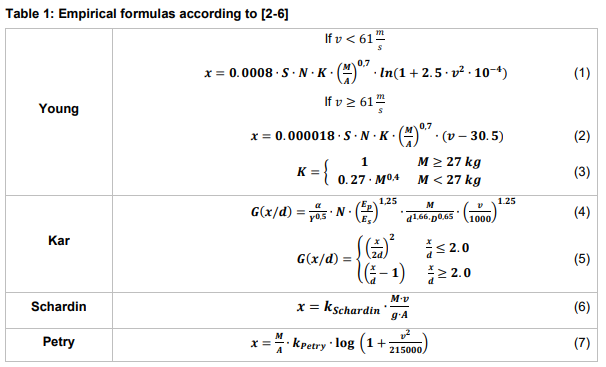
To calculate the penetration depth 𝑥 of a projectile into the soil, various empirical formulas are recommended according to current guidelines (see Equation (1) – (7)). The status report of the Nuclear Safety Standards Commision (KTA) [1] refers to the approaches of Young [2, 3], Kar [4], Schardin [5] and Petry [6], which are based on experimental data with non-deformable projectiles (see Table 1).
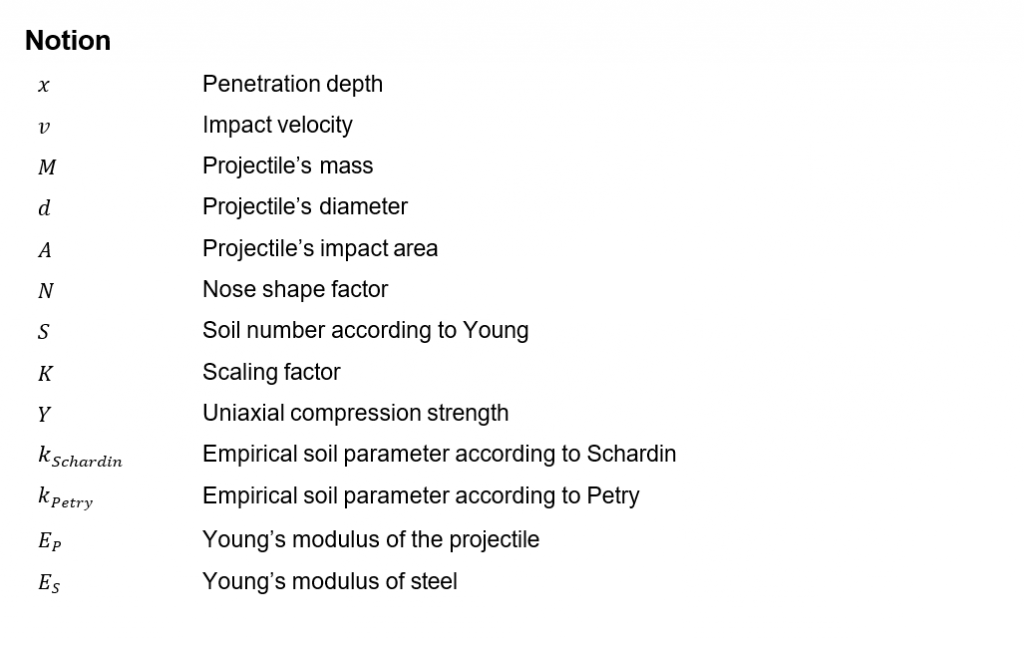
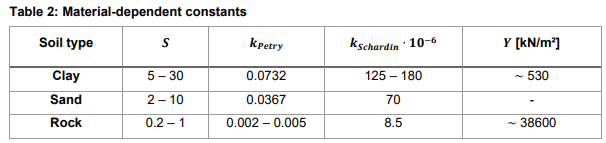
The input parameters of the empirical penetration formulas include details about the projectile’s geometry, such as the diameter 𝑑 and the impact area 𝐴, as well as its mass 𝑀 and impact speed 𝑣. The soil is considered in the calculations, either with an empirical parameter related to the type of soil according to Table 2, or a mechanical characteristic depending on the formula used.
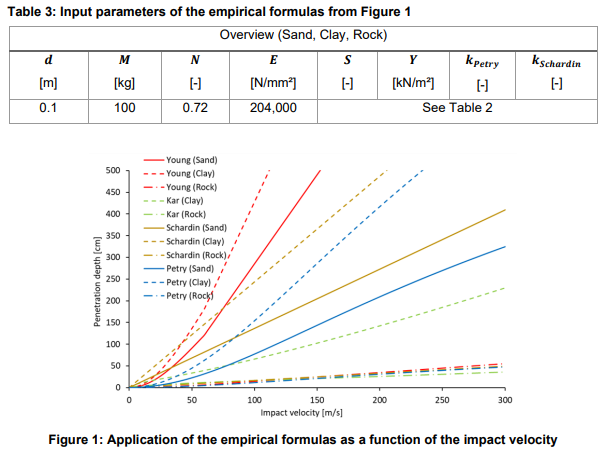
The diagram in Figure 1 provides an overview of the calculated penetration depth of projectiles into various soil types as a function of impact velocity. The soil material is differentiated into sand, clay, and rock. The remaining parameters are listed in Table 3.
NOVEL NUMERICAL METHOD
In addition to empirical approaches, it is also possible to analyse the mechanical effects of a dynamic impact event into the soil using numerical simulations. A continuum-based simulation method does not accurately represent the mechanical behavior of the soil. Due to the highly nonlinear material response, a novel combined solution using the Discrete Element Method (DEM) for the soil and the Finite Element Method (FEM) for the projectile is introduced in the following.
The Discrete Element Method is a simulation technique based on the principles developed by Cundall and Strack [7]. It enables the modeling of granular material using spheres and disks. In this method, each particle is assigned numerical properties, such as size, elastic modulus, or density. By selecting sufficiently small time step, it can be ensured that external influences propagate only between neighboring elements. The interaction between individual particles and other elements is achieved through spring-damper contact models, following Newton’s second axiom. In the simplest case, the total force acting on a particle 𝑖 with mass 𝑚𝑖, velocity 𝑣𝑖, and displacement 𝑢𝑖 is the sum of the gravitational force 𝐹𝐺 and the contact force 𝐹𝐶 (see Equation (8)). Due to the large number of collisions between particles, the equations of motion are typically integrated using numerically explicit methods.

In the modeling of soil materials, the size of each discrete element is limited by computational capacity. Therefore, achieving convergence between the actual global material behavior and the scaling of individual elements is essential. Material calibration is crucial in this context.
STUDIES ON SELECTED IMPACT TESTS
Table 4 shows shows the test setup data of the selected hard impact tests conducted as a part of a joint project involving eleven electric power companies in Japan and published by Koyanagi et al. [8] and Mihara et al. [9].

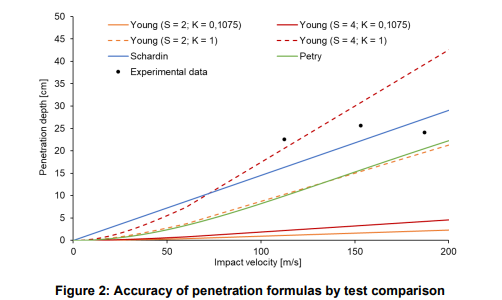
For the impact tests with normal impact angle, penetration depth is determined using the presented empirical formulas (see Figure 2). Due to the mass of the projectile, the Young formula is beyond its application limits. Considering the adjustment factor for low projectile masses results in a significant underestimation of the penetration depth when compared to the experimental data. Setting this factor equal to 1 yields better results. Both Schardin and Petry formula underestimate the penetration depth of the projectile.
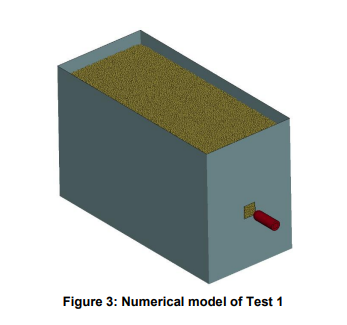
The dynamic numerical simulations are performed using a 3D fully coupled analysis (see Figure 3). The projectile is modeled using volume elements, and the sand is modeled with discrete elements contained within a shell element. An elasto-plastic material model is used for the projectile. For the projectile, the average mesh size is set to 5 mm and the radius of the discrete elements in a range of 1 – 2 mm. The discrete elements have been calibrated through various tests to accurately represent both macroscopic and microscopic material properties of the target material.
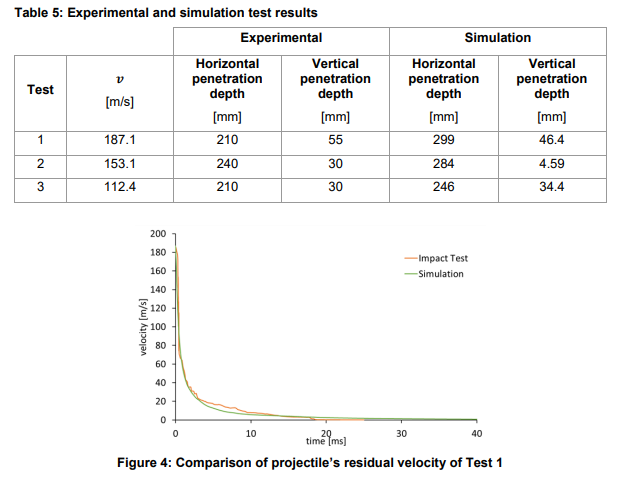
The numerical simulation results are presented in Table 5. The combined solution of FEM and DEM shows good agreement in both the horizontal and vertical penetration depth. Additionally, the velocity time history of Test 1 is used for validation purposes, as illustrated in Figure 4. The simulation results closely align with the experimental data.
CONCLUSION
This paper presents empirical and numerical approaches for analysing the protective effect of soil. A comparison of the empirical formulae reveals a scattering of the calculated penetration depths. Subsequent investigations will apply these empirical formulas to a large database, assessing and verifying their applicability and application limits.
Furthermore, a combined numerical solution using DEM and FEM was introduced for estimating penetration depths and investigating the protective effectiveness of the soil. The DEM enables a realistic behaviour of granular material and is therefore very well suited for modelling the soil under impact loads. The numerical simulations show good agreement with the experimental data. To enhance the reliability of the combined numerical solution, its application should be extended to a broader experimental database. Especially the scaling of the discrete elements should be further investigated.
REFERENCES
- Kerntechnischer Ausschuss (KTA), “Sachstandsbericht zum Regelvorhaben KTA2105: Schutz von KKW gegen anlageninterne Bruchstücke”, Salzgitter, Germany (1994).
- Young, W., “Depth Predictions for Earth-Penetrating Projectiles”, Journal of the Soil Mechanics and Foundations, Vol. 95, Issue 3, Albuquerque, New Mexico, USA (1969).
- Young, W., “Penetration equations”, Sandia National Laboratories, Albuquerque, New Mexico, USA (1997).
- Kar, K., “Projectile Penetration of earth media”, Proceedings of Structural mechanics in reactor technology 4, San Francisco, USA, (1977).
- Schardin, , Molitz, H., Schöner, G., “Wirkungen von Spreng- und Atombomben auf Bauwerke”, Ziviler Luftschutz, Nr. 12, S. 283-291, Koblenz, Germany (1954).
- Amirikian, , “Design of Protective Structures (A New Concept of Structural Behavior)”, Proceedings of the annual meeting of the American Society of Civil Engineering, Chicago, Illinois, USA (1950).
- Cundall, , Strack, O., “A discrete numerical model for granular assemblies”, Géotechnique,
Vol. 29, No. 1, S. 47-65 (1979).
- Koyanagi, , Tsugura, T., Aoyama et al., “Experimental Study in Soil Penetration Evaluation Against Rigid Missile Impacts (1) Test Program and Test Results”, Proceedings of Structural mechanics in reactor technology 25, Charlotte, North Carolina, USA (2019).
- Mihara, , Tsugura, T., Koyanagi, T., et al., “Experimental Study on Soil Penetration Evaluation Against Rigid Missile Impacts (2) Evaluation and Simulation Analyses of Test Results”, Proceedings of Structural mechanics in reactor technology 25, Charlotte, North Carolina, USA (2019).
ACKNOWLEDGEMENTS
The work has been performed within the framework of Nuclear Safety Research Program of the German Federal Ministry for the Environment, Nature Conservation, Nuclear Safety and Consumer Protection (BMUV).
0 Comments